

Table of Contents
English Explanation: Mora vs Syllable in Japanese
In Japanese, there are two units to describe sound: mora and syllable.
- A mora is a unit of rhythm in Japanese. Each mora takes roughly the same amount of time to pronounce. The rhythm of Japanese haiku (5-7-5) and the beat of kana (syllabic characters) are based on morae.
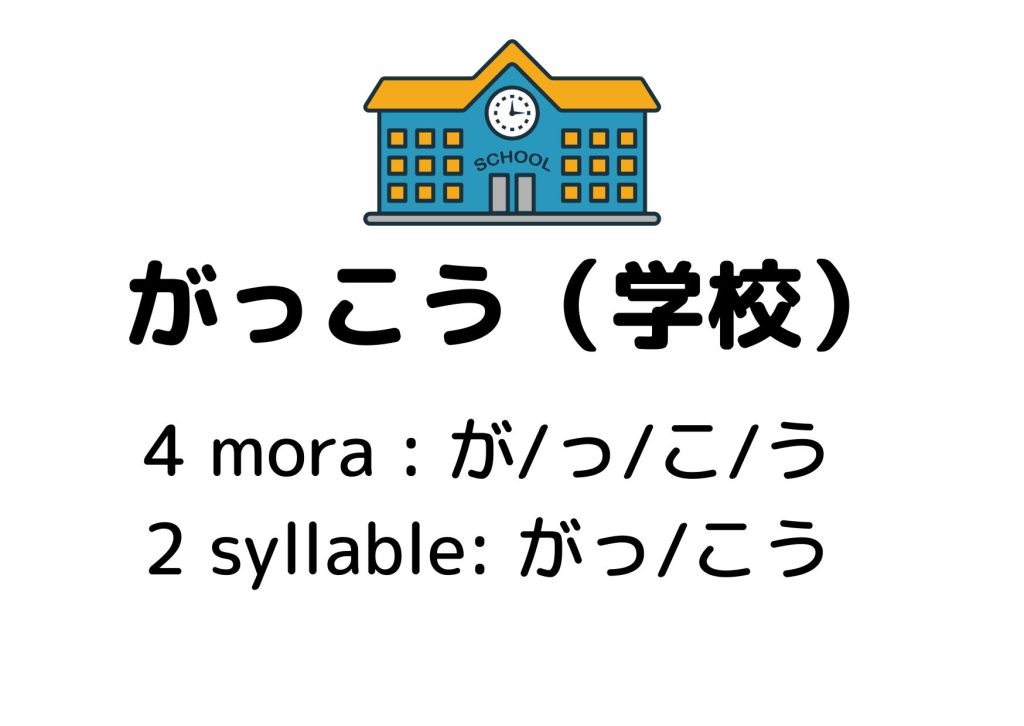
For example, the word gakkou(がっこう / “school”)has four mora: が/っ/こ/う. - A syllable, on the other hand, is a unit of pronunciation centered around a vowel. In languages like English, syllables are the main rhythmic unit, but in Japanese they are not emphasized as much
In syllables, gakkou(がっこう / “school”) is counted as “がっ/こう”, so it has two syllables. - Characters like っ (small tsu), ー (long vowel mark), and ん (n) each count as one mora, but they are not counted as full syllables.
- Small kana like ょ (yo) and ゃ (ya) are also not separate morae—they combine with the consonant to form a single mora.For example, “kyo” (きょ) or “kya” (きゃ) each count as one mora.
日本語:モーラと音節の違い
日本語には、「モーラ(拍)」と「音節」という2つの音の単位があります。
- モーラ(拍)は、リズムの単位です。1つのモーラはだいたい同じ長さで発音されます。日本語の俳句(5・7・5)や、かな1文字ごとのリズムはモーラに基づいています。たとえば「がっこう(学校)」は、が・っ・こ・うの4モーラです。
- 音節(シラブル)は、母音を中心とした発音のまとまりの単位です。英語など多くの言語では音節がリズムの基本ですが、日本語ではあまり使われません。「がっこう」は、音節で数える「がっ/こう」(2音節)です。
- 「っ(促音)」「ー(長音)」「ん(撥音)」などは1文字で1モーラになりますが、音節には数えません。
- 「ょ」「ゃ」などの拗音で1モーラに数えません。「きょ」「きゃ」で1モーラと数えます。
English: How to Count Morae and Syllables in Japanese
| Category | Mora (モーラ) | Syllable (音節) |
|---|---|---|
| Basic rule | One kana = 1 mora | A unit centered around a vowel |
| Small tsu (っ) | Counts as 1 mora | Usually not counted as a separate syllable |
| N (ん) | Counts as 1 mora | Usually not counted as a separate syllable |
| Long vowel (ー) | Counts as 1 mora | Usually not counted as a separate syllable |
| Contracted sounds (kya, sho) | 1 mora | 1 syllable |
| Example: gakkou | ga – small tsu – ko – u = 4 morae | gak / kou = 2 syllables |
● How to count mora
- Each kana (hiragana or katakana) is usually one mora
- Small tsu (っ), n (ん), and long vowel mark (ー) count as one mora each
- Contracted sounds like kya, sho count as one mora
- Example: gakkou = 4 morae (ga – small tsu – ko – u)
● How to count syllables
- A syllable is based on a vowel-centered sound unit
- Contracted sounds (e.g., kya) = 1 syllable
- っ, ん, ー are usually not counted as separate syllables
- Example: gakkou = 2 syllables (gak–kou)
日本語:モーラと音節の数え方の基本ルール
| 項目 | モーラ(mora) | 音節(syllable) |
|---|---|---|
| 基本ルール | ひらがな1文字は通常1モーラ | 母音を中心とする発音のまとまりが1音節 |
| 促音(っ) | 1モーラとして数える | 数えない |
| 撥音(ん) | 1モーラとして数える | 数えない |
| 長音(ー) | 1モーラとして数える | 数えない |
| 拗音(きゃ等) | 1モーラ | 1音節 |
| 例:がっこう | が・っ・こ・う(4モーラ) | がっ/こう(2音節) |
● モーラ(拍)の数え方
- ひらがな1文字は通常1モーラ(例:か=1モーラ)
- 「っ(促音)」「ん(撥音)」「ー(長音)」も1モーラとして数える
- 拗音(きゃ、しょ など)も1モーラ
- 例:がっこう(が・っ・こ・う)=4モーラ
● 音節(シラブル)の数え方
- 母音を中心とする発音のまとまりが1音節
- 拗音(きゃ、しょ)なども1音節
- 「っ」「ん」「ー」は音節には含まれないことが多い
- 例:がっこう(がっ/こう)=2音節
Syllables vs Morae in Japanese: A Beginner-Friendly Comparison Table
日本語初級学習者向けの、音節とモーラの違いを説明する表です。この表の単語(名詞)はすべて「ひらがなの数」=「モーラの数」になっています。例えば「はし」は2文字で、モーラ数は「2」です。
This chart is for beginner learners of Japanese. All the nouns listed here have the same number of hiragana characters and moras. For example, the word “はし” has two hiragana characters and two moras.
| 単語(かな+ローマ字) | 漢字 | English | モーラ/Mora | 音節/Syllables | 指導ポイント / Teaching Point |
|---|---|---|---|---|---|
| はし(hashi) | 橋/箸 | bridge / chopsticks | 2 | 1 or 2 | モーラ数は同じでも、アクセントや意味が異なる(橋・箸) Same mora count, but pitch accent or meaning different |
| おと(oto) | 音 | sound | 2 | 2 | モーラと音節が一致するシンプルな例 Simple example which mora and syllable match |
| ほん(hon) | 本 | book | 2 | 1 | 「ん」は1モーラだが音節としては数えない ん (n) is one mora, but not count as one syllable |
| がっこう(gakkou) | 学校 | school | 4 | 2 がっ/こう | 小さい「っ」や長音「ー」も1モーラとして数える 「っ」and 「ー」each count as one mora |
| おばあさん(obaasan) | ― | grandmother | 5 | 3 お/ばあ/さん | 長音や「ん」を含み、モーラと音節のズレを説明しやすい |
| にっぽん(nippon) | 日本 | Japan | 4 | 2 にっ/ぽん | 小さい「っ」や「ん」は音節にならないが、モーラとして数える っ and ん add morae, but not syllables |
| ケーキ(keeki) | ― | cake | 3 | 2 ケー/キ | 長音「ー」が1モーラとしてカウントされる Long vowel ー adds a mora |
| ペン(pen) | ― | pen | 2 | 1 | 「ン」は1モーラだが1音節ではない The ン (n) adds a mora |
| パン(pan) | ― | bread | 2 | 1 | 撥音「ン」が音節にならない例 Nasal 「ン」 is one mora but not a syllable |
| カップ(kappu) | ― | cup | 3 | 2 カッ/プ | 促音「ッ」は1モーラとして数えられる Small 「ッ」 is one mora |
以下の表の単語(名詞)は「ひらがなの数」=「モーラの数」ではない単語の例です。例えば「きょう」という単語は3文字ですが、モーラ数は「2」です。
The nouns in the table below are examples where the number of hiragana characters is not equal to the number of moras. For example, the word “きょう” has three characters but only two moras.
| 単語(かな+ローマ字) | 漢字 | English | モーラ/Mora | 音節/Syllables | 指導ポイント / Teaching Point |
|---|---|---|---|---|---|
| きょう(kyou) | 今日 | today | 2 | 1 | 「きょ」は拗音で1モーラ。長音「う」は母音の一部として数える。 “Kyo” is a contracted sound (1 mora); “u” is not a long vowel here, but part of the syllable. |
| がっき(gakki) | 楽器 | instrument | 3 | 2 | 促音「っ」は1モーラとして数えるが、1音節にはならない。 The small “tsu” (っ) counts as one mora, but not as a separate syllable. |
| スーパーマーケット(suupaa maaketto) | ― | supermarket | 9 | 5 | 長音「ー」や促音「ッ」は1文字でも1モーラ。文字数とモーラ数が一致しない代表例。 Long vowels (ー) and small “tsu” (ッ) are each one mora; katakana loanwords often differ in character vs. mora count. |