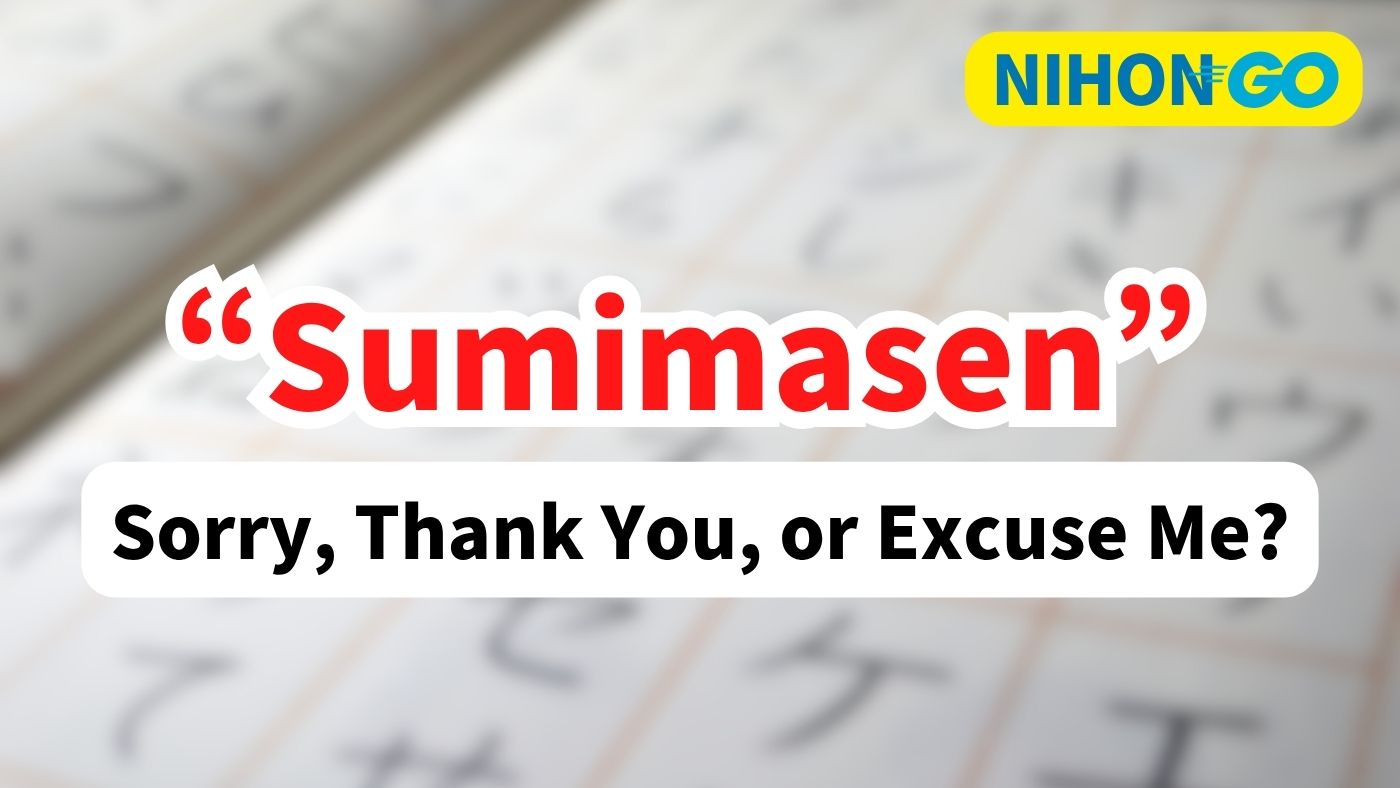
🤔 Why does Sumimasen mean so many things?
In Japanese, the word “sumimasen” (すみません) is incredibly versatile.
You’ll hear it in daily life—at stores, on trains, in restaurants, and more.
But here’s the surprising part:
Depending on the context, it can mean:
- 🧎♀️ Apology – “I’m sorry”
- 🙏 Gratitude – “Thank you”
- 🙋♂️ Getting attention – “Excuse me”
How can one word cover all these different meanings? To understand that, we’ll take a closer look at the origin, nuance, and real-life usage of sumimasen. Let’s explore how this humble phrase works in the Japanese mind—and how you can use it naturally, too.

🏛️ The origin of “sumimasen”
“Sumimasen” is the negative polite form of the verb sumu(済む), which means “to be completed,” “to be finished,” or “to be resolved.” In Japanese grammar, ~ません is the polite negative ending for verbs (e.g., たべません = do not eat).
So:
すみません(sumimasen) literally means:
👉 “It hasn’t been completed” or “It’s not settled.”
This expression implies an emotional or social debt—something is left unfinished between the speaker and the listener. That’s why “sumimasen” is used when:
- You cause inconvenience (apology)
- You receive help (gratitude + guilt)
- You ask for something (attention, request)
In all cases, the speaker feels there is something “unresolved” or “left owing,” and uses sumimasen to politely acknowledge it.
💡 Three Main Uses of “Sumimasen”
1. 🫢 Apology(しゃざい/謝罪)
Used when you’ve done something wrong or caused trouble.
🔹 遅れてすみません。
Sumimasen for being late.
(I’m sorry I caused inconvenience.)
2. 🙇♀️ Gratitude(かんしゃ/感謝)
Used when you receive help and feel sorry someone went out of their way.
🔹 荷物を持ってくれて、すみません。
Thank you for carrying my bag.
(I’m grateful, but also feel bad for the trouble.)
In this case, sumimasen ≠ sorry, but more like “Thanks and sorry combined.”
3. 👋 Attention(呼びかけ)
Used to call someone or ask for help politely.
🔹 すみません、駅はどこですか?
Excuse me, where is the station?
This is the Japanese equivalent of “Excuse me”.
🙋♂️ “Sumimasen” vs. “Suimasen” (Politeness & Style)
Both forms are used in daily conversation—but they differ in formality and tone.
You might often hear people say “suimasen”, which is actually a more casual, colloquial version of “sumimasen.”
It developed later and is commonly used in spoken language, especially in informal settings.
So while “sumimasen” is more polite and appropriate for formal situations, “suimasen” feels a bit lighter and more relaxed.
| Expression | Politeness Level | Common Situations | English Feel |
|---|---|---|---|
| すみません (sumimasen) | More formal | Talking to strangers, at work, polite settings | “Excuse me” / “Sorry” (polite) |
| すいません (suimasen) | Casual / spoken | With friends, casual speech, everyday talk | “Oops, sorry!” / “Thanks” (casual) |
Key Point:
Use すみません in formal or neutral settings.
Use すいません when speaking casually or with close people.
Both are correct—but “suimasen” is considered less formal and mostly used in speech, not writing.
🔄 Related Expressions: “Sumimasen” vs. Other Japanese Phrases
Before we move on to the teaching and learning tips, let’s explore how sumimasen compares to other common Japanese phrases used for apology and gratitude.
🧎♀️ “Sumimasen” vs. “Gomen” / “Gomen nasai” (For Apologies)
All three expressions can be translated as “I’m sorry,” but they differ in formality and social distance.
| Expression | Politeness | Common Contexts | Nuance |
| ごめん | Casual | Friends, family | Light apology |
| ごめんなさい | Polite | Teachers, elders, superiors | Serious or sincere apology |
| すみません | Polite | Strangers, workplace, public spaces | Polite apology with distance |
Key Point:
Use sumimasen when you need to be polite or formal. It’s especially appropriate in public or professional settings.
Use gomen with close friends or family in casual moments.
🙇♀️ “Sumimasen” vs. “Arigatou” (For Gratitude)
Both are used to express thanks—but the focus is slightly different.
| Expression | Focus of Feeling | Common Situations | English Equivalent |
| ありがとう | Positive appreciation | Receiving a gift, good news, kindness | Thank you |
| ありがとうございます | Formal appreciation | Formal situations, with customers, superiors | Thank you very much |
| すみません | Mixed (thanks + apology) | When someone helps you, takes time for you | Thanks (and sorry for the trouble) |
Key Point:
Use sumimasen when someone does something for you and you feel grateful but also bad for causing them trouble.
Use arigatou when you’re just happy and thankful.
📝 Summary Table
| Example (JP) | Usage | English Feel | Example (JP) | When to Use |
|---|---|---|---|---|
| すみません① | Apology | Sorry | 時間に遅れてすみません | You made a mistake |
| すみません② | Gratitude | Thank you | (何かをもらって)わざわざすみません | You feel thankful + guilty |
| すみません③ | Attention | Excuse me | すみません、お会計お願いします | You need help / ask something |
💬 Quiz
🟧 Quiz 1
Aさん(上司):
これ、りょこうの おみやげです。(Kore, ryokō no omiyage desu.)
(Here’s a souvenir from my trip.)
Bさん:
えっ、すいません!ありがとうございます!(E, suimasen! Arigatō gozaimasu!)
(Oh, thank you so much!)
🔍 What does “suimasen!” mean here?
A. Apology
B. Gratitude
C. Getting Attention
🟧 Quiz 2
Aさん(カフェで):
すいませーん、あいすこーひー ください!(Suimasēn, aisu kōhī kudasai!)
(Excuse me, an iced coffee please!)
てんいんさん:
はい、ただいま!(Hai, tadaima!)
(Sure, right away!)
🔍 What does “suimasen!” mean in this context?
A. Apology
B. Gratitude
C. Getting Attention
🟧 Quiz 3
Aさん:
すいません!(Suimasen!)
(かたが ぶつかってしまった)
Bさん:
あっ、だいじょうぶですよ。(A, daijōbu desu yo.)
(Oh, it’s okay.)
🔍 What does “suimasen!” mean in this case?
A. Apology
B. Gratitude
C. Getting Attention
Answer
- B. Gratitude
- C. Getting Attention
- A. Apology
“Sumimasen” is a perfect example of how Japanese expresses both humility and politeness at the same time.
If you’re not sure whether to say “thank you” or “sorry,” chances are “sumimasen” works just fine.
✨ Want to sound more like a native speaker?
Check out my online Japanese lessons and learn how to use words like sumimasen naturally in real conversation!