
What were the most important Japanese buzzwords of 2025?
This article offers a comprehensive, easy-to-read guide to the 2025流行語大賞候補(Japan Buzzword Awards 2025), covering political terms, social issues, youth slang, internet memes, and cultural trends that shaped Japan this year.
As a native Japanese teacher, I explain each keyword in clear English with natural Japanese example sentences, making this guide ideal for intermediate and advanced Japanese learners, as well as anyone researching modern Japanese culture, contemporary society, or trending vocabulary in Japan.
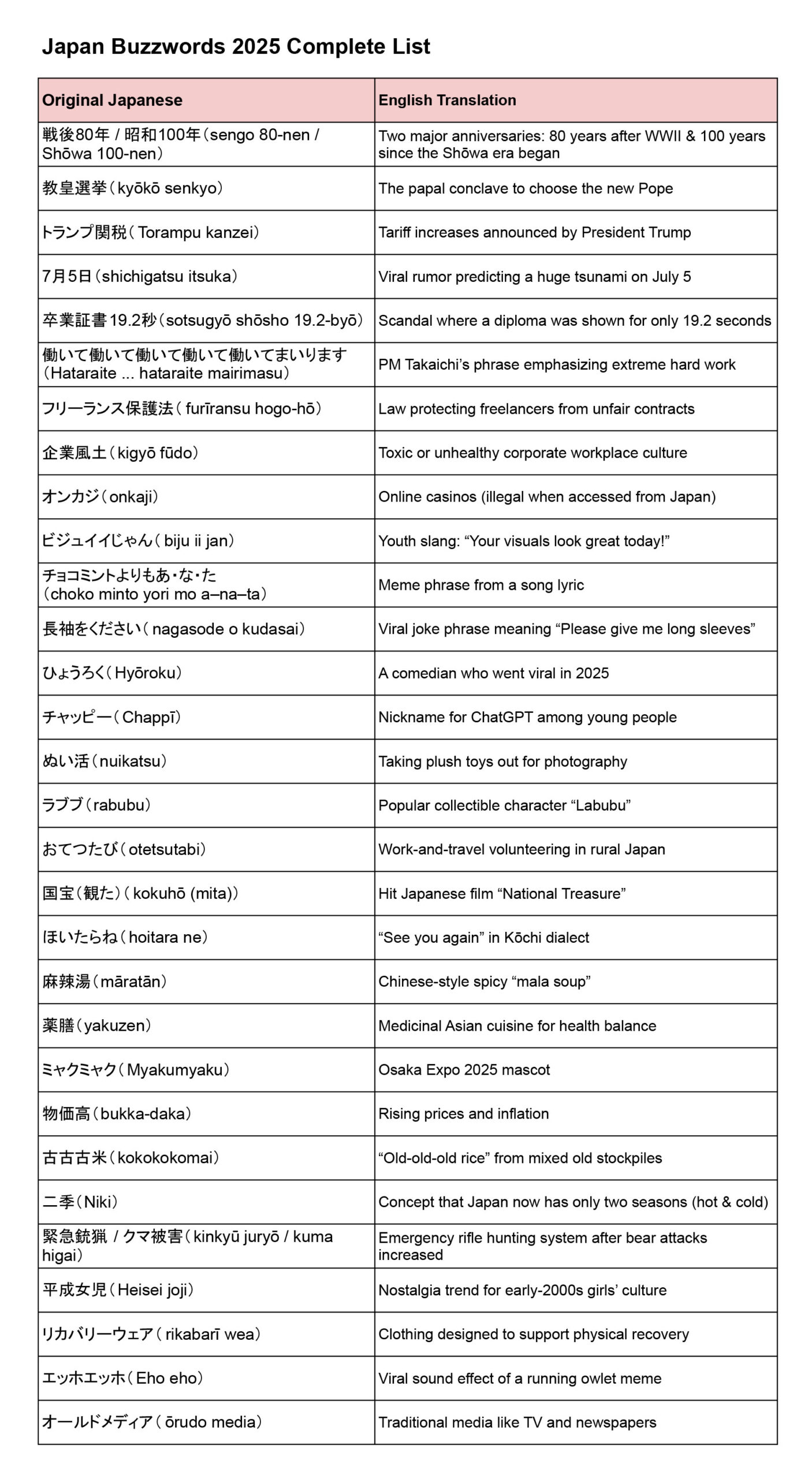
In 2025, Japan experienced major shifts—rising prices(物価高), climate anxiety(二季), viral slang(ビジュイイじゃん / ラブブ), social debates(クマ被害・緊急銃猟), and digital culture trends(チャッピー).These buzzwords reveal not only everyday conversations but also deeper cultural moods, values, and anxieties.
If you want to understand real, up-to-date Japanese, or learn how Japanese people actually speak on social media, TV, and daily conversations, feel free to join my Japanese lessons.
You’ll learn modern expressions, cultural context, and natural Japanese that textbooks don’t teach.
Overview of the 2025 Buzzword Nominees
🌏 Historical & Political Context
These buzzwords reflect Japan’s political shifts, historical anniversaries, and public debates sparked by government actions. Many gained attention through media coverage, viral moments involving politicians, or significant global events that also affected Japan.
戦後80年 / 昭和100年(sengo 80-nen / Shōwa 100-nen)
The year 2025 marks two symbolic anniversaries in Japan:
- 80 years since the end of World War II
- 100 years since the beginning of the Shōwa era
These milestones led to many TV specials, books, and exhibitions reviewing Japan’s modern history.
🇯🇵 Japanese Example Sentence
2025年には、「戦後80年」と「昭和100年」を記念した番組がたくさん放送されました。
(2025-nen ni wa, “sengo hachijū-nen” to “Shōwa hyaku-nen” o kinen shita bangumi ga takusan hōsō saremashita.)
In 2025, many TV programs were broadcast to commemorate “80 years after the war” and “100 years of the Shōwa era.”
教皇選挙(kyōkō senkyo / Conclave)
In 2025, the papal conclave elected Robert Prevost as the new Pope, Leo XIV.
The topic gained attention in Japan partly because a film titled “Kyōkō Senkyo” was also released during this time.
🇯🇵 Japanese Example Sentence
2025年の教皇選挙では、プレボスト枢機卿が新しいローマ教皇に選ばれました。
(2025-nen no kyōkō senkyo de wa, Purebosuto suukikyō ga atarashii Rōma Kyōkō ni erabaremashita.)
In the 2025 conclave, Cardinal Prevost was chosen as the new Pope.
トランプ関税(Torampu kanzei / Trump Tariffs)
After returning to office, President Trump announced unilateral tariff increases that shook the global economy.
Japan was also affected through rising import costs and disrupted supply chains.
🇯🇵 Japanese Example Sentence
トランプ関税の影響で、日本でも食品や原材料の価格が上がりました。
(Torampu kanzei no eikyō de, Nihon demo shokuhin ya gengenyō no kakaku ga agarimashita.)
Because of the Trump tariffs, prices of food and raw materials also rose in Japan.
7月5日(shichigatsu itsuka / “July 5th” rumor)
A manga-inspired rumor claiming a massive tsunami would occur on July 5 at 4:18 AM spread widely—especially in Hong Kong.
The rumor caused flight reductions, but nothing actually happened.
🇯🇵 Japanese Example Sentence
「7月5日に大津波が来る」といううわさが広まり、航空便が減便される騒ぎになりました。
(“Shichigatsu itsuka ni ōtsunami ga kuru” to iu uwasa ga hiromari, kōkūbin ga genbin sareru sawagi ni narimashita.)
A rumor that a huge tsunami would hit on July 5 spread widely, even leading to reduced flights.
卒業証書19.2秒(sotsugyō shōsho 19.2-byō)
A mayor accused of falsifying her academic background briefly showed her diploma for only 19.2 seconds—an odd moment that went viral and fueled suspicion.
🇯🇵 Japanese Example Sentence
市長が卒業証書を「19.2秒だけ見せた」ことが、さらに疑いを深める結果になりました。
(Shichō ga sotsugyō shōsho o “jūkyū-ten-ni-byō dake miseta” koto ga, sara ni utagai o fukameru kekka ni narimashita.)
The mayor showing her diploma for “only 19.2 seconds” made people even more suspicious.
働いて働いて働いて働いて働いてまいります / 高市早苗首相
(hatarai-te, hatarai-te, hatarai-te, hatarai-te, hatarai-te mairimasu)
Japan’s first female Prime Minister Sanae Takaichi declared she would “work and work and work,” which sparked debate about overwork and the country’s work–life balance culture.
🇯🇵 Japanese Example Sentence
新首相の「働いて働いて…まいります」という発言は、日本の働き方をめぐる議論を呼びました。
(Shin-shushō no “hatarai-te hatarai-te… mairimasu” to iu hatsugen wa, Nihon no hatarakikata o meguru giron o yomimashita.)
The new prime minister’s statement “I will work and work…” sparked debate about Japan’s work culture.
フリーランス保護法(furīransu hogo-hō / Freelance Protection Law)
A law implemented in 2024 to protect freelancers from unfair contracts and exploitative business practices.
It aims to create safer, more transparent working conditions for independent workers.
🇯🇵 Japanese Example Sentence
フリーランス保護法によって、個人で働く人の取引条件が改善されつつあります。
(Furīransu hogo-hō ni yotte, kojin de hataraku hito no torihiki jōken ga kaizen saretsutsu arimasu.)
Thanks to the Freelance Protection Law, working conditions for freelancers are gradually improving.
企業風土(kigyō fūdo / Toxic Corporate Culture)
In 2025, the phrase kigyō fūdo drew attention when a major TV network mishandled a misconduct case.
The incident highlighted a deeper issue in Japan: workplaces where “everyone senses the problem, but no one feels able to speak up.”
This term became widely discussed in the media as an example of unhealthy corporate culture.
🇯🇵 Japanese Example Sentence
企業風土の問題が表面化し、「声を上げにくい雰囲気」が社会的な議論を呼びました。
(Kigyō fūdo no mondai ga hyōmen-ka shi, “koe o age nikui fun’iki” ga shakaiteki na giron o yomimashita.)
Issues in corporate culture became visible, and the “difficulty of speaking up” sparked public debate.
💻 Digital Culture & Youth Slang
This category highlights how quickly online culture evolves in Japan. Many of these phrases spread through TikTok, YouTube, or fandom communities, reflecting the creativity and humor of Gen Z. Some terms show how Japanese youth remix language, pop culture, and internet memes in uniquely playful ways.
オンカジ(onkaji / Online Casino)
“オンカジ(Onkaji)” is short for “オンラインカジノ (online casino)”.While online casinos may be legal overseas, gambling for money from within Japan is illegal.
The term became widely discussed after several public figures were found to have used such services.
🇯🇵 Japanese Example Sentence
オンカジを利用すると、日本では賭博罪になる可能性があります。
(Onkaji o riyō suru to, Nihon de wa tobakuzai ni naru kanōsei ga arimasu.)
Using an online casino can be considered illegal gambling in Japan.
ビジュイイじゃん(biju ii jan / “You look so good today!”)
A viral phrase from the song “Ii jan” by the group M!LK.
It comes from the expression 「ビジュアルいいじゃん」 (bijuaru ii jan, “Your visuals look great!”), and fans use it to praise someone’s appearance — similar to saying “You look so good today!”
🇯🇵 Japanese Example Sentence
今日ビジュイイじゃん!その服すごく似合ってるよ。
(Kyō biju ii jan! Sono fuku sugoku niatteru yo.)
You look amazing today! That outfit really suits you.
チョコミントよりもあ・な・た(choko minto yori mo a–na–ta)
A catchphrase used by the idol unit AiScReam from the Love Live! series.
The dramatic spoken line “choko minto yori mo a-na-ta” went viral on TikTok for its cute delivery.
It literally means “I like you more than chocolate-mint ice cream.”
🇯🇵 Japanese Example Sentence
「チョコミントよりもあ・な・た」のセリフ部分がかわいいと、TikTokで大量に使われました。
(“Choko minto yori mo a–na–ta” no serifu bubun ga kawaii to, TikTok de taryō ni tsukawaremashita.)
The spoken line “choko minto yori mo a-na-ta” became widely used on TikTok because of its cute delivery.
長袖をください(nagasode o kudasai / “Please give me long sleeves”)
A viral phrase from the comedy show Wednesday’s Downtown.
Comedian Tsuda Atsuhiro said this unexpectedly during a skit, and viewers found the randomness so funny that it became a meme.
🇯🇵 Japanese Example Sentence
番組で津田さんが突然「長袖をください」と言ったことで、一気にネットミームになりました。
(Bangumi de Tsuda-san ga totsuzen “nagasode o kudasai” to itta koto de, ikki ni netto mīmu ni narimashita.)
When Tsuda suddenly said “Please give me long sleeves” on the show, it instantly became an internet meme.
ひょうろく(Hyōroku / name of a comedian)
“Hyōroku” is the stage name of a freelance comedian known for his mysterious, unreadable facial expressions.
He gained mainstream attention after appearing in several hit dramas between 2024 and 2025.
🇯🇵 Japanese Example Sentence
ひょうろくさんの「素なのか演技なのかわからない表情」が話題になり、一気に知名度が上がりました。
(Hyōroku-san no “su na no ka engi na no ka wakaranai hyōjō” ga wadai ni nari, ikki ni chimeido ga agarimashita.)
Hyōroku’s “is it real or acting?” expression became a hot topic and quickly boosted his popularity.
チャッピー(Chappī / “Chappy” – nickname for ChatGPT)
“Chappy” is a playful nickname that some Japanese users started using for ChatGPT.
Many people treat the AI almost like a friend—sharing complaints, joking around, or asking for casual advice—leading to the affectionate shorthand “チャッピー”.
🇯🇵 Japanese Example Sentence
最近は、AIに悩みを相談する人が増えて、「チャッピー」という呼び名も定着してきました。
(Saikin wa, AI ni nayami o sōdan suru hito ga fuete, “Chappī” to iu yobina mo teichaku shite kimashita.)
Recently, more people are turning to AI for advice, and the nickname “Chappy” has become common.
🎎 Lifestyle & Subculture
These words capture emerging hobbies, travel styles, and cultural trends in Japan. From plushie photography to work-and-travel volunteering and film-driven cultural shifts, they show how people—especially younger generations—are redefining leisure, identity, and community engagement.
ぬい活(nuikatsu / Plushie Outings)
“Nuikatsu” refers to activities where people take their favorite plush toys (“nuigurumi”) out with them — putting them in bags, photographing them at cafés, travel spots, or daily scenes.
The term is a shortened form of “ぬいぐるみ(nuigurumi)” + “活動(katsudō) (activities)”, and it has become a popular style of “oshi-katsu” (supporting one’s favorite character).
🇯🇵 Japanese Example Sentence
休日は、ぬいぐるみと一緒にカフェで写真を撮る「ぬい活」を楽しんでいます。
(Kyūjitsu wa, nuigurumi to issho ni kafe de shashin o toru “nuikatsu” o tanoshindeimasu.)
Because nuikatsu is trending, many people now take plushies to cafés, parks, and tourist spots.
ラブブ(rabubu / Labubu)
“Rabubu” refers to Labubu, a monster-like character designed by a Hong Kong artist.
It exploded in popularity after BLACKPINK’s Lisa shared it on social media, making it a viral collectible among young fans.
🇯🇵 Japanese Example Sentence
ラブブは人気が高く、限定デザインはすぐに完売してしまいます。
(Rabubu wa ninki ga takaku, gentei dezain wa sugu ni kanbai shite shimaimasu.)
Labubu figures are so popular that limited editions sell out immediately.
おてつたび(otetsutabi / Work-and-Travel Volunteering)
“Otetsutabi” combines otetsudai (helping/working) and tabi (travel).
It connects short-term workers with rural businesses—such as farms and inns—that need help.
It has grown in popularity as a way to travel cheaply while supporting local communities.
🇯🇵 Japanese Example Sentence
夏休みに、おてつたびで北海道の農家を手伝いながら旅行しました。
(Natsuyasumi ni, otetsutabi de Hokkaidō no nōka o tetsudainagara ryokō shimashita.)
During summer break, I traveled through Hokkaido while helping a local farm through otetsutabi.
国宝(観た)(kokuhō (mita) / “National Treasure” the Film)
“National Treasure (Kokuhō)” is the title of a hit Japanese film about a man raised in a traditional performing-arts household who dedicates fifty years of his life to kabuki.
Despite being over three hours long, it became a major box-office success and inspired many viewers to experience kabuki for the first time.
🇯🇵 Japanese Example Sentence
映画『国宝』を観て、初めて歌舞伎に興味を持ったという人が多いそうです。
(Eiga “Kokuhō” o mite, hajimete kabuki ni kyōmi o motta to iu hito ga ōi sō desu.)
Many people say they became interested in kabuki for the first time after watching National Treasure.
ほいたらね(hoitara ne / “See you again” in Kōchi dialect)
“Hoitara ne” means “see you later” in the Kochi (Shikoku) dialect.
The phrase became popular nationwide thanks to the NHK morning drama Anpan, where the soft, gentle delivery of the narrator captured viewers’ hearts.
🇯🇵 Japanese Example Sentence
ドラマの影響で、「ほいたらね」という高知の方言が全国でも親しまれるようになりました。
(Dorama no eikyō de, “hoitara ne” to iu Kōchi no hōgen ga zenkoku demo shitashimareru yō ni narimashita.)
Thanks to the drama, the Kochi-dialect phrase “hoitara ne” became well-loved across Japan.
麻辣湯(māratān / spicy “mala soup” dish)
Málàtàng is a Chinese spicy soup flavored with Sichuan pepper and chili.
It gained rapid popularity in Japan as people sought out bold, numbing flavors (“shibikara”) and customizable ingredients.
🇯🇵 Japanese Example Sentence
最近はシビカラ料理が人気で、麻辣湯の専門店も増えています。
(Saikin wa shibikara ryōri ga ninki de, māratān no senmonten mo fuete imasu.)
Recently, numbing–spicy dishes have become popular, and restaurants specializing in málàtàng are increasing.
薬膳(yakuzen / medicinal Asian cuisine)
“Yakuzen” refers to a traditional dietary approach based on Chinese medicine principles.
A popular NHK drama in 2024 boosted interest, especially among women seeking healthier lifestyles, stress recovery, and balanced nutrition.
🇯🇵 Japanese Example Sentence
ドラマの影響で、薬膳を取り入れた食生活に興味を持つ人が増えています。
(Dorama no eikyō de, yakuzen o toriireta shokuseikatsu ni kyōmi o motsu hito ga fuete imasu.)
Because of the drama, more people are becoming interested in including yakuzen dishes in their daily diet.
ミャクミャク(Myakumyaku / Osaka Expo mascot)
“Myakumyaku” is the official mascot for the 2025 Osaka–Kansai Expo.
Initially criticized as “scary” or “weird,” it later became hugely popular thanks to its unique design and abundant merchandise.
🇯🇵 Japanese Example Sentence
ミャクミャクの人気が急上昇し、関連グッズはどれも早い段階で売り切れました。
(Myakumyaku no ninki ga kyūjōshō shi, kanren guzzu wa dore mo hayai dankai de urikiremashita.)
Myakumyaku’s popularity skyrocketed, and many related goods sold out quickly.
🏛️ Social Issues & Public Debate
This group represents the challenges Japan faced in 2024–2025: rising living costs, environmental stress, wildlife-human conflict, and debates over rural depopulation and cultural identity. These buzzwords reflect a society grappling with rapid change and uncertainty while seeking new solutions.
物価高(bukka-daka / Rising Prices)
Japan has been experiencing long-lasting price increases due to high energy costs, raw material shortages, and global economic instability.
Many households feel the impact in their daily expenses.
🇯🇵 Japanese Example Sentence
物価高が続き、食料品や日用品の値上がりに多くの人が苦しんでいます。
(Bukka-daka ga tsuzuki, shokuryōhin ya nichiyōhin no neagari ni ōku no hito ga kurushinde imasu.)
Rising prices continue, and many people are struggling with higher costs for food and daily necessities.
古古古米(kokokokomai / Old-Old-Old Rice)
The term kokokokomai refers to rice that has been stored for several years.
During Japan’s “rice shortage” in 2025, the government released reserve rice, and the labels “old rice / older rice / even older rice” became a surprising topic of conversation.
People lined up to buy cheaper rice, and the naming system itself became a buzzword.
🇯🇵 Japanese Example Sentence
古古古米の販売が話題になり、多くの人が安いお米を求めて列を作りました。
(Kokokokomai no hanbai ga wadai ni nari, ōku no hito ga yasui okome o motomete retsu o tsukurimashita.)
The sale of “old-old-old rice” became a hot topic, and many people lined up to buy cheaper rice.
二季(Niki / Two-Season Climate)
Japan’s traditional four seasons are becoming less distinct due to climate change.
Instead of spring–summer–autumn–winter, the climate increasingly shifts between just “hot” and “cold.”
🇯🇵 Japanese Example Sentence
地球温暖化の影響で、春や秋が短くなり「二季化」が進んでいると言われています。
(Chikyū ondanka no eikyō de, haru ya aki ga mijikaku nari “niki-ka” ga susunde iru to iwarete imasu.)
Because of global warming, spring and autumn are becoming shorter, leading to what some call a “two-season climate.”
緊急銃猟 / クマ被害(kinkyū juryō / kuma higai)
Japan has seen a rapid rise in serious bear encounters, especially in northern regions such as Iwate and Akita.
As “urban bears” increasingly appear in residential areas, the government introduced a new system on September 1 that allows city mayors to authorize rifle hunting within populated areas during emergencies.
The policy sparked debate about public safety, wildlife management, and environmental change.
🇯🇵 Japanese Example Sentence
クマの出没が相次いだため、市街地でも銃猟を認める「緊急銃猟」の制度が導入されました。
(Kuma no shutsubotsu ga aitsui da tame, shigaichi demo juryō o mitomeru “kinkyū juryō” no seido ga dōnyū saremashita.)
The increasing number of bear sightings led to the introduction of an emergency hunting system that allows rifle use even in city areas.
平成女児(Heisei joji / “Heisei girls” nostalgia trend)
This word refers to women who were elementary-school students in the late 1990s to early 2000s—during the Heisei era.
The trend celebrates nostalgic “kawaii” items from that time: pastel colors, ribbons, glitter pens, collectibles, and character goods.
🇯🇵 Japanese Example Sentence
平成女児ブームで、子どもの頃に使っていた文房具やアクセサリーが再び人気になっています。
(Heisei joji būmu de, kodomo no koro ni tsukatte ita bunbōgu ya akusesarī ga futatabi ninki ni natte imasu.)
Many items that Heisei-era girls used as children—like stationery and accessories—are becoming popular again.
リカバリーウェア(rikabarī wea / recovery wear)
Recovery wear is clothing made from special fibers designed to improve blood circulation and promote rest.
It became popular among people struggling with fatigue, poor sleep, or stiff shoulders.
🇯🇵 Japanese Example Sentence
リカバリーウェアを寝る前に着ると、肩こりや疲労が軽くなると感じる人も多いです。
(Rikabarī wea o neru mae ni kiru to, katakori ya hirō ga karuku naru to kanjiru hito mo ōi desu.)
Many people feel that wearing recovery wear before sleeping helps reduce fatigue and shoulder stiffness.
エッホエッホ(Eho eho / sound effect for running owlet meme)
This term comes from a viral photo of a barn owl chick running earnestly through the grass.
People captioned the image with the cute onomatopoeia “エッホエッホ,” expressing its determined little steps.
🇯🇵 Japanese Example Sentence
草むらを走るフクロウのヒナに「エッホエッホ」という擬音をつけた画像がSNSで大流行しました。
(Kusamura o hashiru fukurou no hina ni “eho eho” to iu gion o tsuketa gazō ga SNS de dairū kō shimashita.)
A picture of a running owl chick with the caption “eho eho” went viral on social media.
オールドメディア(ōrudo media / “old media” such as TV & newspapers)
“Old media” refers to traditional outlets like newspapers and TV.
As TikTok-style short clips spread rapidly and influence public opinion, some people criticize old media as outdated or slow.
🇯🇵 Japanese Example Sentence
若者の間では、テレビや新聞を「オールドメディア」と呼び、情報源としてあまり使わない人もいます。
(Wakamono no aida de wa, terebi ya shinbun o “ōrudo media” to yobi, jōhōgen to shite amari tsukawanai hito mo imasu.)
Among young people, TV and newspapers are sometimes called “old media,” and many don’t use them as primary information sources.
Conclusion
The 2025 Japan Buzzword List shows how quickly language changes with politics, entertainment, social issues, and internet culture.From serious topics like 物価高 and クマ被害 to fun expressions like ビジュイイじゃん and ラブブ, these 30 words capture the emotions, humor, and concerns of people living in Japan today.
For Japanese learners, these buzzwords are more than slang—they are a window into how people actually speak, what they worry about, and what’s trending in everyday life.
Understanding them helps you follow Japanese news, social media, and conversations more naturally.
If you’d like to learn modern Japanese expressions with clear explanations from a native teacher, I’d be happy to help you in my lessons.
Source : https://www.nippon.com/ja/japan-data/h02599/
For Learners Who Want to Study More Japanese
If you want to understand real, modern Japanese—the kind you see in news articles, social media, and everyday conversations—I’d love to help you in my lessons.
I teach Japanese in a clear and friendly way, focusing on:
- Natural expressions used by real Japanese people
- Trending phrases, buzzwords, and cultural context
- Easy-to-understand grammar explanations
- Support for English and Indonesian speakers
- Conversation practice for all levels (Beginner to Advanced / JLPT N5–N1)
Whether you want to improve your speaking, understand online slang, or follow Japanese media more confidently, my lessons are designed to help you progress quickly while having fun.
👉 Book a Japanese lesson with me here:
https://www.italki.com/ja/teacher/12449522
I look forward to helping you discover more about today’s Japanese language and culture! 🇯🇵✨