
Complete 品詞(Hinshi)List
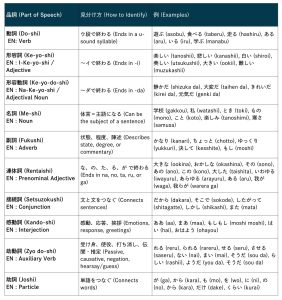
Here is a complete list of Japanese parts of speech.
| 品詞 (Part of Speech) | 見分け方 (How to Identify) | 例 (Examples) |
|---|---|---|
| 動詞 (Do-shi) EN: Verb | ウ段で終わる (Ends in a u-sound syllable) | 遊ぶ (asobu), 食べる (taberu), 走る (hashiru), ある (aru), いる (iru), 学ぶ (manabu) |
| 名詞 (Me-shi) EN : Noun | 体言=主語になる (Can be the subject of a sentence) | 学校 (gakkou), 私 (watashi), とき (toki), もの (mono), こと (koto), 楽しみ (tanoshimi), 寒さ (samusa) |
| 形容詞 (Ke-yo-shi) EN : I-Ke-yo-shi / Adjective | ~イで終わる (Ends in -i) | 楽しい (tanoshii), 悲しい (kanashii), 白い (shiroi), 美しい (utsukushii), 大きい (ookii), 難しい (muzukashii) |
| 形容動詞 (Ke-yo-do-shi) EN : Na-Ke-yo-shi / Adjectival Noun | ~ダで終わる (Ends in -da) | 静かだ (shizuka da), 大変だ (taihen da), きれいだ (kirei da), 元気だ (genki da) |
| 副詞 (Fukushi) EN : Adverb | 状態、程度、陳述 (Describes state, degree, or commentary) | かなり (kanari), ちょっと (chotto), ゆっくり (yukkuri), 決して (kesshite), もし (moshi) |
| 連体詞 (Rentaishi) EN : Prenominal Adjective | な、の、た、る、が で終わる (Ends in na, no, ta, ru, or ga) | 大きな (ookina), おかしな (okashina), その (sono), あの (ano), この (kono), 大した (taishita), いわゆる (iwayuru), あらゆる (arayuru), ある (aru), 我が (waga), 我らが (warera ga) |
| 接続詞 (Setsuzokushi) EN : Conjunction | 文と文をつなぐ (Connects sentences) | だから (dakara), そこで (sokode), したがって (shitagatte), しかし (shikashi), また (mata) |
| 感動詞 (Kando-shi) EN : Interjection | 感動、応答、挨拶 (Emotions, response, greetings) | ああ (aa), まあ (maa), もしもし (moshi moshi), はい (hai), おはよう (ohayou) |
| 助動詞 (Jo do-shi) EN : Auxiliary Verb | 受け身、使役、打ち消し、伝聞・推定 (Passive, causative, negation, hearsay/guess) | れる (reru), られる (rareru), せる (seru), させる (saseru), ない (nai), まい (mai), そうだ (sou da), らしい (rashii), ようだ (you da), そうだ (sou da) |
| 助詞 (Joshi) EN : Particle | 単語をつなぐ (Connects words) | が (ga), から (kara), も (mo), を (wo), に (ni), の (no), から (kara), だけ (dake), くらい (kurai) |
You can save/download image version from belows↓
Verbs (動詞 / dōshi)
Verbs express actions or states. In Japanese, they always appear at the end of the sentence.
10 Common Japanese Verbs:
- 行く (iku) → 行かない (ikanai) – to go → not go
- 来る (kuru) → 来ない (konai) – to come → not come
- 見る (miru) → 見ない (minai) – to see → not see
- する (suru) → しない (shinai) – to do → not do
- 食べる (taberu) → 食べない (tabenai) – to eat → not eat
- 飲む (nomu) → 飲まない (nomanai) – to drink → not drink
- 話す (hanasu) → 話さない (hanasanai) – to speak → not speak
- 書く (kaku) → 書かない (kakanai) – to write → not write
- ある (aru) → ない (nai) – to exist (non-living) → not exist
- いる (iru) → いない (inai) – to exist (living) → not exist
Example:
「明日、学校に行きます。」
Ashita, gakkō ni ikimasu.
“I will go to school tomorrow.”
3 Verb Groups in Japanese
In Japanese language learning, verbs are typically divided into three groups based on how they conjugate:
🔴 Group 1: Godan Verbs (五段動詞)
Also called u-verbs, these verbs end in a u-sound (e.g., -ku, -su, -mu, -ru, etc.) in their dictionary form.
When conjugating, the final syllable changes across five rows (a, i, u, e, o).
Examples:
- 書く (kaku) – to write
- 話す (hanasu) – to speak
- 飲む (nomu) – to drink
🟡 Group 2: Ichidan Verbs (一段動詞)
Also called ru-verbs or vowel-stem verbs. These verbs end in -eru or -iru and have a more regular pattern.
To conjugate, you drop the る and add endings directly.
Examples:
- 食べる (taberu) – to eat
- 見る (miru) – to see
- 起きる (okiru) – to wake up
🟢 Group 3: Irregular Verbs (不規則動詞)
There are only two common irregular verbs in Japanese:
- する (suru) – to do
- 来る (kuru) – to come
They don’t follow standard rules and must be memorized separately.
Note:
- Verbs always come at the end of a Japanese sentence.
- Verb forms change to show tense, politeness, negation, and mood.
- Verbs are essential to Japanese grammar—they’re the engine of the sentence.
- Learning verb groups and conjugation patterns is key to fluency.
Nouns (名詞 / meishi)
Nouns are used to name people, things, places, or ideas. They are the core of any sentence and often appear as subjects or objects.
10 Common Japanese Nouns:
- 日本 (Nihon) – Japan
- 人 (hito) – person
- 時間 (jikan) – time
- 名前 (namae) – name
- 学校 (gakkō) – school
- 友だち (tomodachi) – friend
- 会社 (kaisha) – company
- 子ども (kodomo) – child
- 水 (mizu) – water
- 先生 (sensei) – teacher
Example:
「先生の名前は田中さんです。」
Sensei no namae wa Tanaka-san desu.
“The teacher’s name is Mr. Tanaka.”
Note:
- Japanese nouns have no gender, no plural, and no articles (like “a” or “the”).
- They often appear with particles to show their grammatical role.
- Many nouns can be turned into verbs or adjectives by adding suffixes like する or な.
- Some abstract ideas in English are expressed with nouns in Japanese (e.g. tanoshimi = enjoyment).
I-Adjectives (形容詞 / keiyōshi)
i-Adjectives end in 「〜い」 and are conjugated to express tense, negation, or politeness. They directly describe nouns and are used frequently to express feelings, qualities, or states.
🧠 How to form the negative:
Replace the final 「い」 with 「くない」
e.g., 楽しい → 楽しくない
10 Common i-Adjectives with Negative Forms:
- 楽しい (tanoshii) → 楽しくない (tanoshikunai) – fun → not fun
- 寒い (samui) → 寒くない (samukunai) – cold → not cold
- 大きい (ookii) → 大きくない (ookikunai) – big → not big
- 小さい (chiisai) → 小さくない (chiisakunai) – small → not small
- 新しい (atarashii) → 新しくない (atarashikunai) – new → not new
- 古い (furui) → 古くない (furukunai) – old → not old
- 速い (hayai) → 速くない (hayakunai) – fast → not fast
- 遅い (osoi) → 遅くない (osokunai) – slow → not slow
- 難しい (muzukashii) → 難しくない (muzukashikunai) – difficult → not difficult
- 美しい (utsukushii) → 美しくない (utsukushikunai) – beautiful → not beautiful
Example:
「この映画は楽しいです。」
Kono eiga wa tanoshii desu.
“This movie is fun.”
Note:
- I-adjectives always end in ~い, including in their dictionary form.
- They conjugate like verbs: to express past, negation, or politeness.
- These adjectives directly modify nouns or end a sentence.
- Be careful not to confuse them with na-adjectives, which look similar but don’t conjugate the same way.
Na-Adjectives (形容動詞 / keiyō-dōshi)
Na-Adjectives don’t conjugate directly. Instead, they use 「だ」 in plain form and require 「な」 when modifying a noun. They often describe abstract states or qualities.
🧠 How to form the negative:
Replace 「だ」 with 「じゃない」 (casual) or 「ではない」 (formal)
e.g., 静かだ → 静かじゃない
10 Common na-Adjectives with Negative Forms:
- 静かだ (shizuka da) → 静かじゃない (shizuka janai) – quiet → not quiet
- きれいだ (kirei da) → きれいじゃない (kirei janai) – beautiful/clean → not beautiful
- 有名だ (yūmei da) → 有名じゃない (yūmei janai) – famous → not famous
- 元気だ (genki da) → 元気じゃない (genki janai) – energetic → not energetic
- 親切だ (shinsetsu da) → 親切じゃない (shinsetsu janai) – kind → not kind
- 大切だ (taisetsu da) → 大切じゃない (taisetsu janai) – important → not important
- 危険だ (kiken da) → 危険じゃない (kiken janai) – dangerous → not dangerous
- 簡単だ (kantan da) → 簡単じゃない (kantan janai) – easy → not easy
- 上手だ (jōzu da) → 上手じゃない (jōzu janai) – skillful → not skillful
- 特別だ (tokubetsu da) → 特別じゃない (tokubetsu janai) – special → not special
Example:
「静かな場所で勉強したいです。」
Shizuka na basho de benkyō shitai desu.
“I want to study in a quiet place.”
Note:
- Na-adjectives require な when modifying a noun: e.g., きれいな人.
- When used at the end of a sentence, they attach to だ, です, or conjugated forms.
- Many kanji-based words (like 静か or 有名) fall into this category.
- These words behave more like nouns grammatically, but act as adjectives in meaning.
Adverbs (副詞 / fukushi)
Adverbs in Japanese modify verbs, adjectives, or entire sentences to describe how, how much, or when something happens.
They’re commonly used in both spoken and written Japanese, and their position in a sentence is fairly flexible.
💡 In Japanese, it’s also very common to combine two adverbs to express more nuance or soften the tone.
10 Common Japanese Adverbs:
- ゆっくり (yukkuri) – slowly
- すぐ (sugu) – immediately / soon
- とても (totemo) – very
- ちょっと (chotto) – a little / kind of
- だいたい (daitai) – roughly / approximately
- けっこう (kekkō) – fairly / pretty
- よく (yoku) – often / well
- まだ (mada) – still / yet
- もう (mō) – already
- たぶん (tabun) – probably
✅ Example 1:
今日はとても寒いです。
Kyō wa totemo samui desu.
“It’s very cold today.”
✅ Example 2:
まだよく分かりません。
Mada yoku wakarimasen.
“I still don’t really understand.”
✅ Example 3:
もうたぶん無理だと思います。
Mō tabun muri da to omoimasu.
“I think it’s probably already impossible.”
Note:
Using two adverbs together like “mada yoku” or “mō tabun” is natural in Japanese and helps convey uncertainty, softness, or emotional nuance.
This technique is especially common in spoken language to avoid sounding too direct.
Prenominal Adjectives (連体詞 / rentaishi)
Rentaishi are a unique category of words in Japanese that only appear in front of nouns.
They function similarly to adjectives, but they never conjugate and cannot appear at the end of a sentence.
💡 Some kosoado (こそあど) words—like この, その, あの, どの—are also classified as rentaishi.
10 Common Japanese Prenominal Adjectives:
- この (kono) – this 🔹 kosoado
- その (sono) – that 🔹 kosoado
- あの (ano) – that (over there) 🔹 kosoado
- どの (dono) – which 🔹 kosoado
- ある (aru) – a certain / some
- 我が (waga) – our / my (formal / poetic)
- いわゆる (iwayuru) – so-called
- 大きな (ookina) – big (before noun only)
- 小さな (chiisana) – small (before noun only)
- 大した (taishita) – considerable / significant
✅ Example 1:
この本は面白いです。
Kono hon wa omoshiroi desu.
“This book is interesting.”
✅ Example 2:
いわゆる専門家が話しました。
Iwayuru senmonka ga hanashimashita.
“A so-called expert spoke.”
Note:
- These words must come before a noun and cannot be used alone.
- While some of them look like adjectives (ookina, chiisana), they don’t conjugate like regular i- or na-adjectives.
- This class is small but high-frequency, especially in spoken and written Japanese.
- Words like この / その / あの / どの are part of the kosoado demonstrative system, and function exclusively as rentaishi.
Conjunctions (接続詞 / setsuzokushi)
接続詞 (setsuzokushi) are words that connect sentences, clauses, or phrases.
They help indicate logical relationships like cause and effect, contrast, sequence, or addition.
Unlike particles or auxiliary verbs, conjunctions stand at the beginning of a new sentence or clause, and are grammatically independent.
10 Common Japanese Conjunctions:
- そして (soshite) – and then
- だから (dakara) – so / therefore
- しかし (shikashi) – however / but
- それから (sorekara) – after that
- けれども (keredomo) – although / but
- つまり (tsumari) – in other words / that is
- また (mata) – also / again
- ところが (tokoroga) – however (unexpectedly)
- それに (soreni) – in addition
- したがって (shitagatte) – accordingly / thus
✅ Example 1:
今日は雨です。だから、出かけません。
Kyō wa ame desu. Dakara, dekakemasen.
“It’s raining today. So I’m not going out.”
✅ Example 2:
映画は楽しかった。でも、少し長すぎた。
Eiga wa tanoshikatta. Demo, sukoshi nagasugita.
“The movie was fun. But it was a bit too long.”
Note:
- Conjunctions do not conjugate or attach to other words.
- They begin a sentence or clause and make the flow of conversation or writing more coherent.
- Many of these overlap with discourse markers in natural Japanese conversation.
Interjections (感動詞 / kandōshi)
感動詞(kandōshi) are words that express emotions, reactions, or greetings.
They often stand alone and are commonly used in spoken Japanese.
They don’t modify or relate grammatically to other words in the sentence—they’re independent and expressive.
10 Common Japanese Interjections:
- ああ (aa) – ah / oh
- まあ (maa) – well / oh my
- えっ (e) – what!? / huh!?
- うわっ (uwa) – whoa!
- へえ (hee) – really!? / wow
- はい (hai) – yes
- いいえ (iie) – no
- もしもし (moshi moshi) – hello (on the phone)
- おはよう (ohayō) – good morning
- ありがとう (arigatō) – thank you
✅ Example 1:
へえ、知らなかった!
Hee, shiranakatta!
🟩 “Wow, I didn’t know that!”
✅ Example 2:
もしもし、田中です。
Moshi moshi, Tanaka desu.
“Hello, this is Tanaka speaking.” (on the phone)
Note:
- Interjections are standalone words that reflect emotion, surprise, acknowledgment, or greeting.
- They’re extremely common in casual speech, anime, and manga.
- Many interjections have intonation variations that change their meaning or nuance (e.g.「えっ?」vs「えぇ〜」).
- Some interjections can also signal active listening, like「うん」「へぇ」「なるほど」.
Auxiliary Verbs (助動詞 / jodōshi)
助動詞(jodōshi) are small words that attach to verbs or adjectives to express tense, negation, passive voice, causative, possibility, or hearsay.
They cannot stand alone and must be attached to another word.
Unlike full verbs, they serve a grammatical function, not a lexical one.
10 Common Japanese Auxiliary Verbs:
- ない (nai) – not (negation)
- た (ta) – past tense
- ます (masu) – polite form
- たい (tai) – want to ~
- られる (rareru) – potential or passive
- させる (saseru) – causative
- そうだ (sō da) – it seems / I heard
- ようだ (yō da) – it appears / like
- らしい (rashii) – apparently / seemingly
- まい (mai) – probably won’t / shall not
✅ Example 1:
行かない
Ikanai
“(I) don’t go”
👉 Verb 行く (iku) + auxiliary ない (nai)
✅ Example 2:
食べたい
Tabetai
“(I) want to eat”
👉 Verb 食べる (taberu) + auxiliary たい (tai)
Note:
- Auxiliary verbs always come after the verb or adjective they modify.
- You can combine several auxiliaries (e.g.「食べられなかった」 = couldn’t eat).
- Learning auxiliaries helps build natural-sounding and grammatically correct Japanese.
- They are essential for expressing mood, politeness, intent, and tense.
Particles (助詞 / joshi)
助詞(joshi) are grammatical markers that come after words to show their relationship to other parts of the sentence.
They are essential in Japanese, as word order is flexible and particles help clarify meaning.
Particles indicate subject, object, direction, topic, ownership, contrast, and more.
10 Common Japanese Particles:
- は (wa) – topic marker
- が (ga) – subject marker
- を (wo / o) – direct object marker
- に (ni) – direction, time, or purpose
- へ (e) – direction (like “to”)
- で (de) – location or means
- の (no) – possession (like “of” or ’s)
- と (to) – and / with
- から (kara) – from / because
- まで (made) – until / up to
✅ Example 1:
私は水を飲みます。
Watashi wa mizu o nomimasu.
“I drink water.”
👉 は marks the topic (I), を marks the object (water)
✅ Example 2:
駅に行きます。
Eki ni ikimasu.
“(I) go to the station.”
👉 に shows the direction
Note:
- Some particles have overlapping meanings, but different nuance (e.g., が vs は).
- Spoken and written Japanese often use particles slightly differently.
- Mastering particles is crucial for clear and accurate communication.
- Some particles can be omitted in casual speech, but knowing their function is essential for learners.