
Japanese compound words (複合語) are words formed by combining two or more elements—such as nouns, verbs, or adjectives—into a single meaningful unit, as shown in the table below.
| Group | Combination type | Example | Structure | Resulting parts of speech |
|---|---|---|---|---|
| 1 | Noun + Noun | 家族(family) | 家 (noun: home) + 族 (noun: group / clan) | Noun |
| 2 | Noun + Verb (V stem) | 気配り(consideration / thoughtfulness) | 気 (noun: mind / attention) + 配り (V stem of 配る “to distribute”) | Noun |
| 3 | Noun + Verb (dictionary form) | 気づく(notice / realize) | 気 (noun: mind / awareness) + 付く (verb: become attached) | Verb |
In total, there are 12 common structural patterns, which will be explained later in this article.
If you have reached an advanced level of Japanese, you may have noticed something interesting: Many Japanese words look simple, but they contain surprisingly rich structure inside.
This article is for:
- Advanced Japanese learners
- Grammar lovers and language nerds
- Kanji mania
- Learners aiming to become Japanese teachers
If you enjoy how Japanese works—not just memorizing words—this article is for you.

Why Japanese Compound Words Are So Interesting for Learners
Japanese compound words are fascinating because they compress grammar, meaning, and context into a single word.
Once you understand the patterns behind compound words:
- You can guess the meaning of new words more accurately
- You rely less on dictionaries
- Vocabulary becomes easier to remember
- Learning feels more logical—and more fun
Compound words are not just vocabulary. They are mini grammar systems.
Japanese vs. English Compound Words: Key Structural Differences
A compound word is a word made from two or more elements that function as one unit.
In English, examples include:
- toothbrush
- snowman
- rainfall
English compound words usually combine nouns, and their internal grammar is often unclear or fixed by convention.
A Key Difference: Japanese Compound Words
Japanese compound words are very different.
Japanese compound words can be formed from:
- Nouns
- Verbs
- Adjectives
However, in Japanese language education, noun compounds are the main focus, because they are the most productive and structurally rich.
Most importantly:
👉 Japanese compound words preserve grammatical relationships inside the word.
This means that particles like が / を / に / で / から are often hidden inside the compound.
Understanding this is the key to mastering Japanese compounds.
The Head-Final Principle in Japanese Compound Words
In many Japanese compound words, the meaningful head (the core meaning) comes at the end.
This is called the head-final principle.
Examples
- 雨降り (rainfall) → the core meaning is 降り (falling)
- 雪どけ (snowmelt) → the core meaning is とけ (melting)
In these cases, the second element determines what kind of thing the word refers to.
Exceptions to the Rule
There are two major exceptions:
- Head-initial compounds
- 買い物(かいもの) shopping → the core meaning is 物 (things / items)
- 行き先(いきさき) → the core meaning is 先 (destination)
- Parallel compounds (both elements are equal)
- 手足(てあし) hands and feet / limbs → both 手 (hand) and 足 (foot) are equally important
- 親子(おやこ) parent and child → both 親 (parent) and 子 (child) are equally important
- 白黒(しろくろ) black and white → both 白 (white) and 黒 (black) are equally important
These exceptions are important, but the head-final pattern dominates, especially in verbal noun compounds.
12 Pattern of Japanese Compound Words
How to Read the Table Below
The table shows how Japanese compound words are formed by combining different parts of speech. Each example breaks the word into its original elements and explains how the final meaning and part of speech are determined.
Verb stem (語幹 / gokan), also called the masu-stem, is the verb form used before -masu. (e.g. 行き, 食べ, 話し).
| Group | Combination type | Example | Structure | Resulting parts of speech |
|---|---|---|---|---|
| 1 | Noun + Noun | 家族(family) | 家 (noun: home) + 族 (noun: group / clan) | Noun |
| 2 | Noun + Verb (V stem) | 気配り(consideration / thoughtfulness) | 気 (noun: mind / attention) + 配り (V stem of 配る “to distribute”) | Noun |
| 3 | Noun + Verb (dictionary form) | 気づく(notice / realize) | 気 (noun: mind / awareness) + 付く (verb: become attached) | Verb |
| 4 | Noun + i-adjective | 心強い(reassuring / comforting) | 心 (noun: heart) + 強い (i-adjective: strong) | i-adjective |
| 5 | Noun + i-adjective stem | 身近(close / familiar) | 身 (noun: body / self) + 近 (i-adjective stem of 近い “close / near”) | na-adjective |
| 6 | Noun + na-adjective stem | 口下手(poor at speaking) | 口 (noun: mouth) + 下手 (na-adjective stem: unskilled) | na-adjective |
| 7 | Verb (V stem) + Noun | 通り雨(passing shower) | 通り (V stem of 通る “to pass”) + 雨 (noun: rain) | Noun |
| 8 | Verb (V stem) + Verb | 走り出す(start running) | 走り (V stem of 走る) + 出す (verb: begin / move out) | Verb |
| 9 | Verb (V stem) + Verb (V stem) | 回し飲み(sharing drinks / passing a drink around) | 回し (V stem of 回す) + 飲み (V stem of 飲む) | Noun |
| 10 | Verb (V stem) + i-adjective | 蒸し暑い(hot and humid) | 蒸し (V stem of 蒸す) + 暑い (i-adjective: hot) | i-adjective |
| 11 | Verb (V stem) + na-adjective stem | 聞き上手(good listener) | 聞き (V stem of 聞く) + 上手 (na-adjective stem: skillful) | na-adjective |
| 12 | Particle + Particle | には(as for / in / with emphasis) | に (case particle) + は (topic particle) | Particle |
More Examples for Each Group
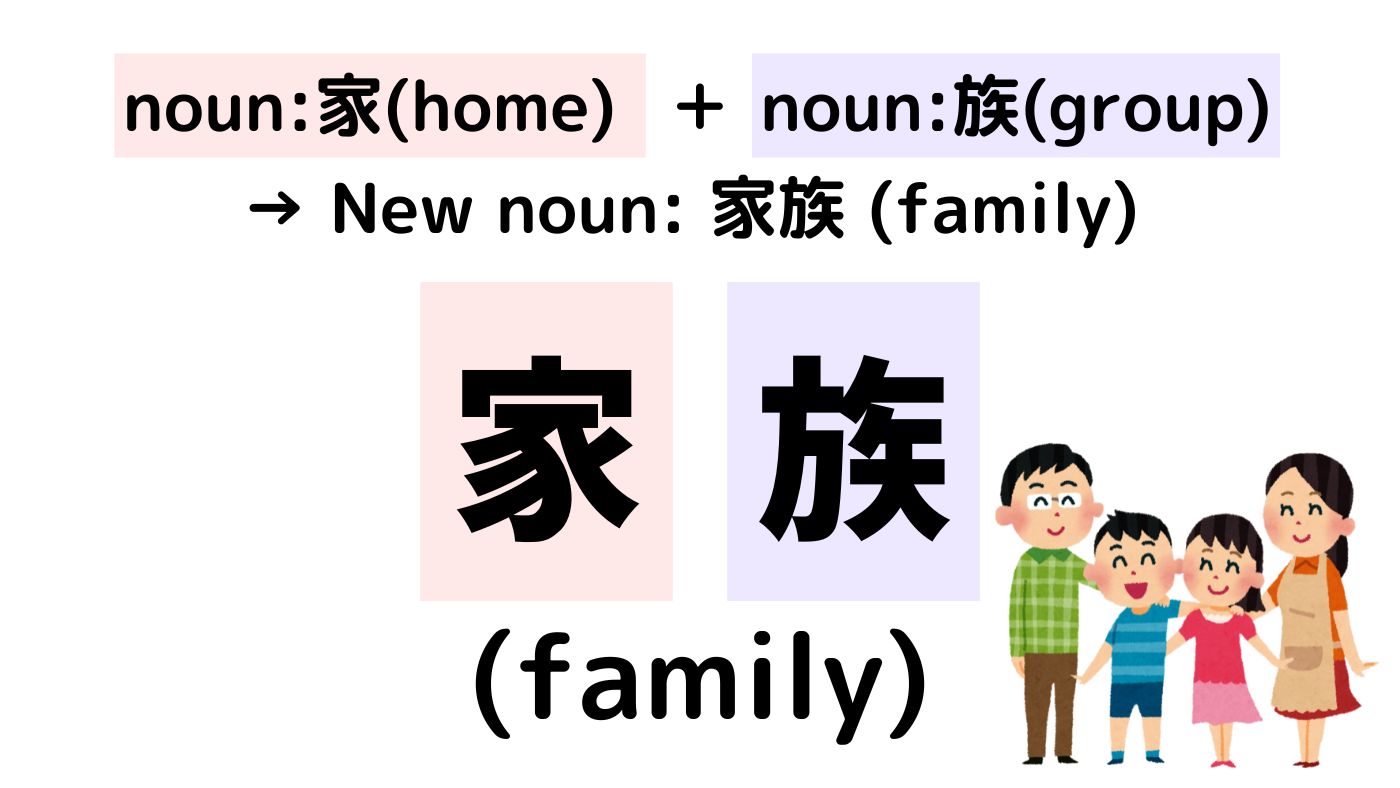
1. Noun + Noun → Noun
object + object → concrete or abstract entity
This pattern combines two nouns to form a single concept.
The second noun often functions as the semantic head, defining what kind of thing the compound refers to.
Many everyday words belong to this group.
- 家族(かぞく|family)
→ 家 (noun: home) + 族 (noun: group / clan) - 駅前(えきまえ|area in front of a station)
→ 駅 (noun: station) + 前 (noun: front) - 雨音(あまおと|sound of rain)
→ 雨 (noun: rain) + 音 (noun: sound) - 手紙(てがみ『letter)
→ 手 (noun: hand) + 紙 (noun: paper) - 週末(しゅうまつ|weekend)
→ 週 (noun: week) + 末 (noun: end)
2. Noun + Verb stem → Noun
entity + action → event or action-noun
Here, a noun combines with a verb stem to create a noun that describes an action or event.
The compound often implies an underlying sentence-like structure.
This pattern is highly productive in Japanese.
- 気配り(きくばり|consideration / thoughtfulness)
→ 気 (noun: mind / attention) + 配り (verb stem of 配る “to distribute”) - 雨宿り(あまやどり|taking shelter from the rain)
→ 雨 (noun: rain) + 宿り (verb stem of 宿る “to take shelter”) - 人見知り(ひとみしり|shyness with strangers)
→ 人 (noun: people) + 見知り (verb stem of 見知る “to become familiar”) - 花見(はなみ|flower viewing)
→ 花 (noun: flower) + 見 (verb stem of 見る “to see”) - 気遣い(きづかい|consideration / care)
→ 気 (noun: mind / feeling) + 遣い (verb stem of 遣う “to use / care for”)
3. Noun + Verb (dictionary form) → Verb
entity + action → new verb
In this pattern, a noun and a verb merge into a single verb.
The noun typically specifies the domain or trigger of the action.
The result behaves as a fully independent verb.
- 気づく(きづく|to notice / realize)
→ 気 (noun: mind / awareness) + 付く (verb: to attach / become aware) - 名付ける(なづける|to name)
→ 名 (noun: name) + 付ける (verb: to attach / give) - 心がける(こころがける|to keep in mind / make an effort)
→ 心 (noun: heart / mind) + がける (verb: to apply oneself) - 目立つ(めだつ|to stand out)
→ 目 (noun: eye) + 立つ (verb: to stand) - 手伝う(てつだう|to help)
→ 手 (noun: hand) + 伝う (verb: to assist / pass along)
4. Noun + i-adjective → i-adjective
entity + property → descriptive quality
A noun modifies an i-adjective to create a more specific description.
The adjective remains the core meaning, while the noun adds context or nuance.
These words often describe states or evaluations.
- 心強い(こころづよい|reassuring)
→ 心 (noun: heart) + 強い (i-adjective: strong) - 奥深い(おくぶかい|profound / deep)
→ 奥 (noun: depth / inner) + 深い (i-adjective: deep) - 名高い(なだかい|famous)
→ 名 (noun: name / reputation) + 高い (i-adjective: high) - 手痛い(ていたい|painful / a hard blow)
→ 手 (noun: hand) + 痛い (i-adjective: painful) - 気まずい(きまずい|awkward / uncomfortable)
→ 気 (noun: mood / atmosphere) + まずい (i-adjective: bad)
5. Noun + i-adjective stem → na-adjective
entity + degree → state or condition
This pattern uses the stem of an i-adjective to form a na-adjective.
The compound often expresses abstract states such as closeness, ease, or attitude.
Many common descriptive words fall into this category.
- 身近(みぢか|close / familiar)
→ 身 (noun: body / self) + 近 (i-adjective stem of 近い “near”) - 気長(きなが|patient / easygoing)
→ 気 (noun: temperament) + 長 (i-adjective stem of 長い “long”) - 身軽(みがる|light / unburdened)
→ 身 (noun: body / self)) + 軽 (i-adjective stem of 軽い “light”) - 身勝手(みがって|selfish)
→ 身 (noun: body / self)) + 勝手 (na-adjective stem: self-centered / selfish)
6. Noun + na-adjective stem → na-adjective
entity + evaluation → trait or tendency
A noun combines with a na-adjective stem to describe characteristics, preferences, or tendencies.
This pattern is frequently used for personality traits and habitual behavior.
It is especially common in descriptions of people.
- 口下手(くちべた|poor at speaking)
→ 口 (noun: mouth) + 下手 (na-adjective stem: unskilled) - 世話好き(せわずき|helpful / caring)
→ 世話 (noun: care) + 好き (na-adjective stem: liking) - 人嫌い(ひとぎらい|disliking people)
→ 人 (noun: people) + 嫌い (na-adjective stem: dislike) - 子供向き(こどもむき|for children)
→ 子供 (noun: children) + 向き (na-adjective stem: suitable) - 要注意(ようちゅうい|needs caution)
→ 要 (noun: need) + 注意 (na-adjective stem: caution)
7. Verb (V stem) + Noun → Noun
ction + entity → thing related to the action
The verb stem indicates an action, while the noun names the resulting thing or object.
The noun is the semantic head of the compound. Many everyday nouns related to activities belong to this group.
- 通り雨(とおりあめ|passing shower)
→ 通り (V stem of 通る “to pass”) + 雨 (noun: rain) - 書き物(かきもの|something to write / writing work)
→ 書き (V stem of 書く) + 物 (noun: thing) - 飲み物(のみもの|drink / beverage)
→ 飲み (V stem of 飲む) + 物 (noun: thing) - 立ち話(たちばなし|chat while standing)
→ 立ち (V stem of 立つ) + 話 (noun: talk) - 買い物(かいもの|shopping)
→ 買い (V stem of 買う) + 物 (noun: thing)
8. Verb (V stem) + Verb → Verb
action + action → complex action
Two verbs combine to express a single, more complex action.
The second verb usually determines the main meaning, such as starting, continuing, or changing an action.
This pattern is very common in spoken Japanese.
- 泣き喚く(なきわめく|cry and scream)
→ 泣き (V stem of 泣く: cry) + 喚く (verb: shout / scream) - 走り出す(はしりだす|start running)
→ 走り (V stem of 走る: run) + 出す (verb: begin / move out) - 泣き出す(なきだす|start crying)
→ 泣き (V stem of 泣く: cry) + 出す (verb: begin) - 話し続ける(はなしつづける|keep talking)
→ 話し (V stem of 話す: speak) + 続ける (verb: continue)
9. Verb (V stem) + Verb (V stem) → Noun
action + action → event, habit, or state
This pattern turns combined actions into a noun.It often refers to repeated behavior, habits, or observable activities.The result functions as a concrete or abstract noun.
- 飲み食い(のみくい|eating and drinking)
→ 飲み (V stem of 飲む: drink) + 食い (V stem of 食う: eat) - 回し飲み(まわしのみ|passing a drink around)
→ 回し (V stem of 回す: pass around) + 飲み (V stem of 飲む: drink) - 立ち話(たちばなし|chatting while standing)
→ 立ち (V stem of 立つ: stand) + 話 (V stem of 話す: talk) - 歩き回り(あるきまわり|walking around / wandering)
→ 歩き (V stem of 歩く: walk) + 回り (V stem of 回る: go around)
10. Verb (V stem) + i-adjective → i-adjective
state/action + quality → physical or emotional tendency)
A verb stem combines with an i-adjective to describe tendencies or sensations.
These compounds are often used for physical states, feelings, or conditions.
They are common in everyday descriptions.
- 蒸し暑い(むしあつい|hot and humid)
→ 蒸し (V stem of 蒸す: steam) + 暑い (i-adjective: hot) - 疲れやすい(つかれやすい|easily tired)
→ 疲れ (V stem of 疲れる: get tired) + やすい (i-adjective: easy) - 冷えやすい(ひえやすい|gets cold easily)
→ 冷え (V stem of 冷える: get cold) + やすい (i-adjective: easy)
11. Verb (V stem) + na-adjective stem → na-adjective
action + quality → personality or behavioral trait
This pattern frequently describes a person’s skills, habits, or personality traits.
The verb suggests behavior, while the adjective stem evaluates it.
Many words describing people fall into this category.
- 聞き上手(ききじょうず|good listener)
→ 聞き (V stem of 聞く: listen) + 上手 (na-adjective stem: skillful) - 話し下手(はなしべた|poor speaker)
→ 話し (V stem of 話す: speak) + 下手 (na-adjective stem: unskilled) - 泣き虫(なきむし|crybaby)
→ 泣き (V stem of 泣く: cry) + 虫 (noun used as a na-adjective-like suffix)
12. Particle + Particle → Particle
function + function → grammatical connector
Two particles combine to create a single grammatical unit.
The second particle often carries the main function, such as emphasis or contrast.
These compounds play an important role in sentence structure.
- には (contrast / emphasis)
→ に (case particle: location / target) + は (topic particle)
例文:この問題には答えがありません。 (There is no answer to this problem.) - でも (even / also / however)
→ で (case particle) + も (addition / emphasis)
例文:子どもでも分かります。(Even a child can understand it.) - からは (from / as for)
→ から (from) + は (topic / contrast)
例文:明日からは忙しくなります。(From tomorrow on, things will get busy.)
Final Thoughts: Why Learning Compound Word Structure Matters
Japanese compound words are more than vocabulary to memorize.
They are compressed grammar, where meaning, structure, and context come together in a single word.
By understanding how compound words are built, you:
- stop treating vocabulary as isolated items
- recognize hidden grammatical relationships
- infer meaning from unfamiliar words
- develop a more systematic and satisfying understanding of Japanese
For advanced learners, this marks a key shift—from learning Japanese to understanding how Japanese works.
Compound words reveal how Japanese organizes meaning:
how actions become nouns, how adjectives grow from verbs, and how particles disappear while their functions remain.
Once you see these patterns, Japanese vocabulary stops feeling random and starts to feel logical, structured, and elegant.
If you enjoy grammar, kanji, or deep language analysis, studying compound words offers one of the clearest windows into the inner logic of Japanese.