Introduction
In Level 1, you learned how to make simple sentences with は (wa) and が (ga)
without comparing them too much.
That was on purpose.
At the beginner level, comparing は and が too early often causes confusion.
So in Level 1, the goal was simple: Just make natural sentences first.
If you can’t make simple sentences yet, start with this article first ⬇︎
Ha and Ga Difference: Level-by-Level Overview
| Level | Learning Stage | Role of は (wa) | Role of が (ga) |
|---|---|---|---|
| 1 | Beginner (N5 early) | Describe things. Sentence topic “talking about ~” 私は学生です。 | Existence / events“exist / happen” 雨が降ります。 |
| 2 | Beginner (N5 late–N4) | What is visible / already shared 私は野田です。 | Choosing / identifying 私が野田です。 |
| 3 | Intermediate (N3) | Known information topic continuation 犬は庭にいます。 | New information first mention 犬が庭にいます。 |
| 4 | Intermediate (N2) | Contrast / generalization コーヒーは飲みます。 | Limitation / emphasis 私が行きます。 |
| 5 | Advanced (N1) | Contextual topic 日本語は難しいが、面白い。 | Information focus 日本語が難しい。 |
| 6 | Advanced (N1+) | Stylistic choice / stance marking 私がやりたい。 | Intentional emphasis 私はやりたい。 |
What You Learn in This Article
In Level 2, we still do not study all grammar rules.
Instead, we focus on:
- simple situations
- speaker intention
- what feels natural in real communication
This level is about one small step forward, not mastering everything.
Key Idea (Level 2)

The difference between は and が is about what is already shared and what needs to be identified.
- は (wa) → talking about something already known or visible
- が (ga) → choosing or identifying one person or thing
Both sentences can be correct Japanese. The difference is why you say them.
私は野田です。
(Watashi wa Noda desu.)
Meaning behind the sentence
- “About me, my name is Noda.”
- The speaker is talking about themselves as a topic
- Neutral sentence
- No strong emphasis
This sentence simply gives information.

Natural situation: Self-introduction
初めまして。
私は野田です。
長野出身です。
よろしくお願いします。
Why は is natural here:
- The speaker is already visible
- Everyone knows who is speaking
- You are not choosing between people
- You are just sharing information
👉 は is natural.
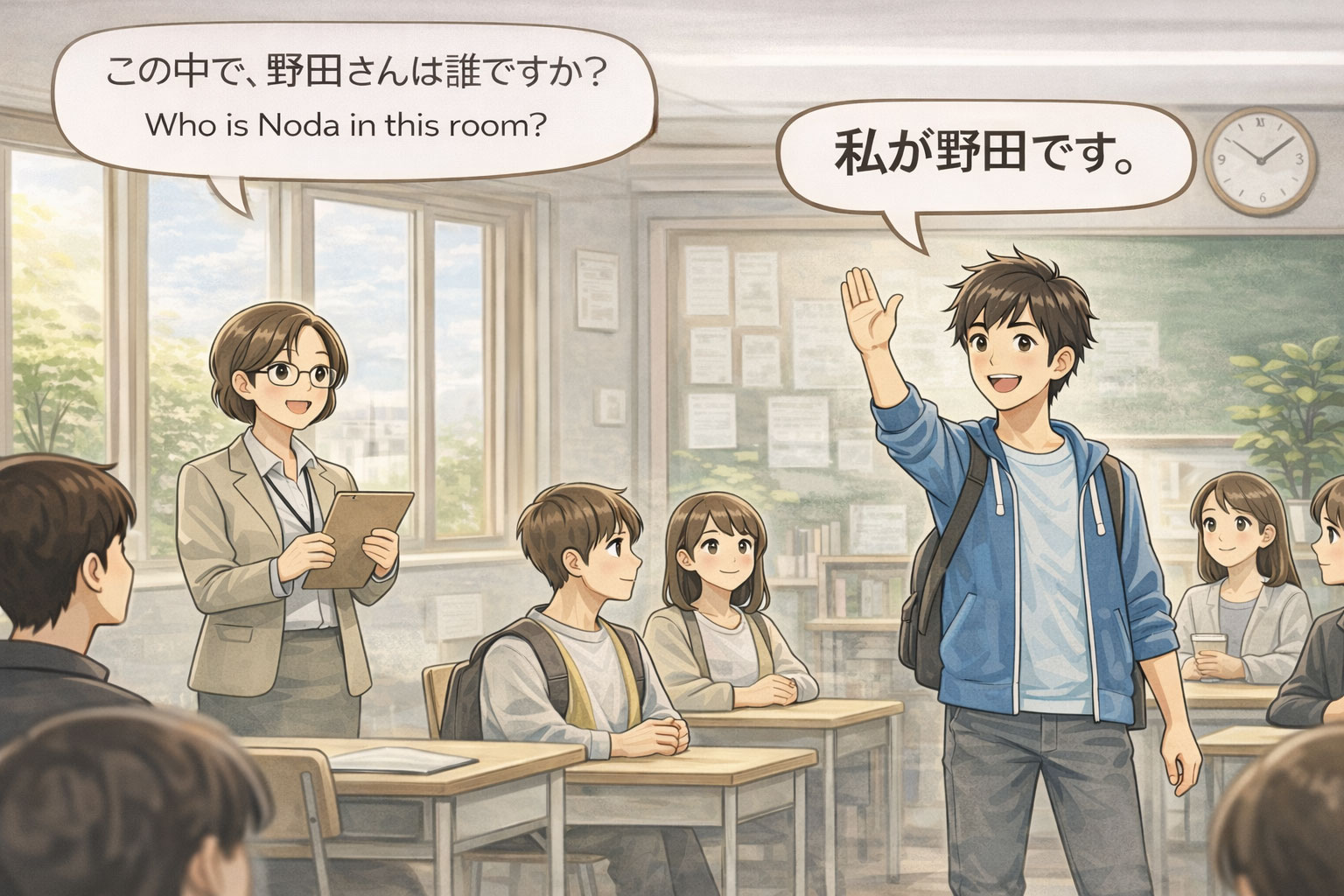
私が野田です。
(Watashi ga Noda desu.)
Meaning behind the sentence
- “I am the one called Noda.”
- The speaker is identifying themselves
- Strong focus on “me”
- There are other possible people
In simple English feeling:
👉 “私が野田です”
(Not a direct translation, but a similar feeling)
Natural situation: Identifying a person
- There are many students in a classroom
- An office staff member enters
- They ask: “この中で、野田さんは誰ですか?(Who is Noda in this room?) ”
- One student answers:
私が野田です。
Why が is natural here:
- The listener does not know who Noda is
- One correct person must be chosen
- The speaker is answering a question
👉 が is natural.
Simple Way to Think About It
は (wa)
- already shared
- already visible
- general information
“This sentence is about X.”
が (ga)
- choosing
- identifying
- answering “who?” or “which one?”
“X is the one.”
Important Note for Beginners
- は and が are both correct
- Do not choose by memorizing rules
- Choose by situation and intention
- が sounds strong, so do not overuse it
Native speakers do not think: “Which particle rule should I use?”
They think: “What am I trying to do in this situation?”
Summary: Difference Between は and が (Level 2)
- 私は野田です。
→ Self-introduction, neutral information - 私が野田です。
→ Identifying yourself, answering “who?”
Same words. Different intention.
What’s Next? (Level 3 Preview)
In Level 3, you will learn about:
- new information
- contrast
- emphasis
Japanese particles are learned step by step, not all at once.