
What Are Japanese Complex Sentences?
A complex sentence means that two ideas are connected into one sentence.
This idea is the same in English.
English example
「I didn’t go out because it was raining.」
Japanese example
「雨が降ったから、行きませんでした。」
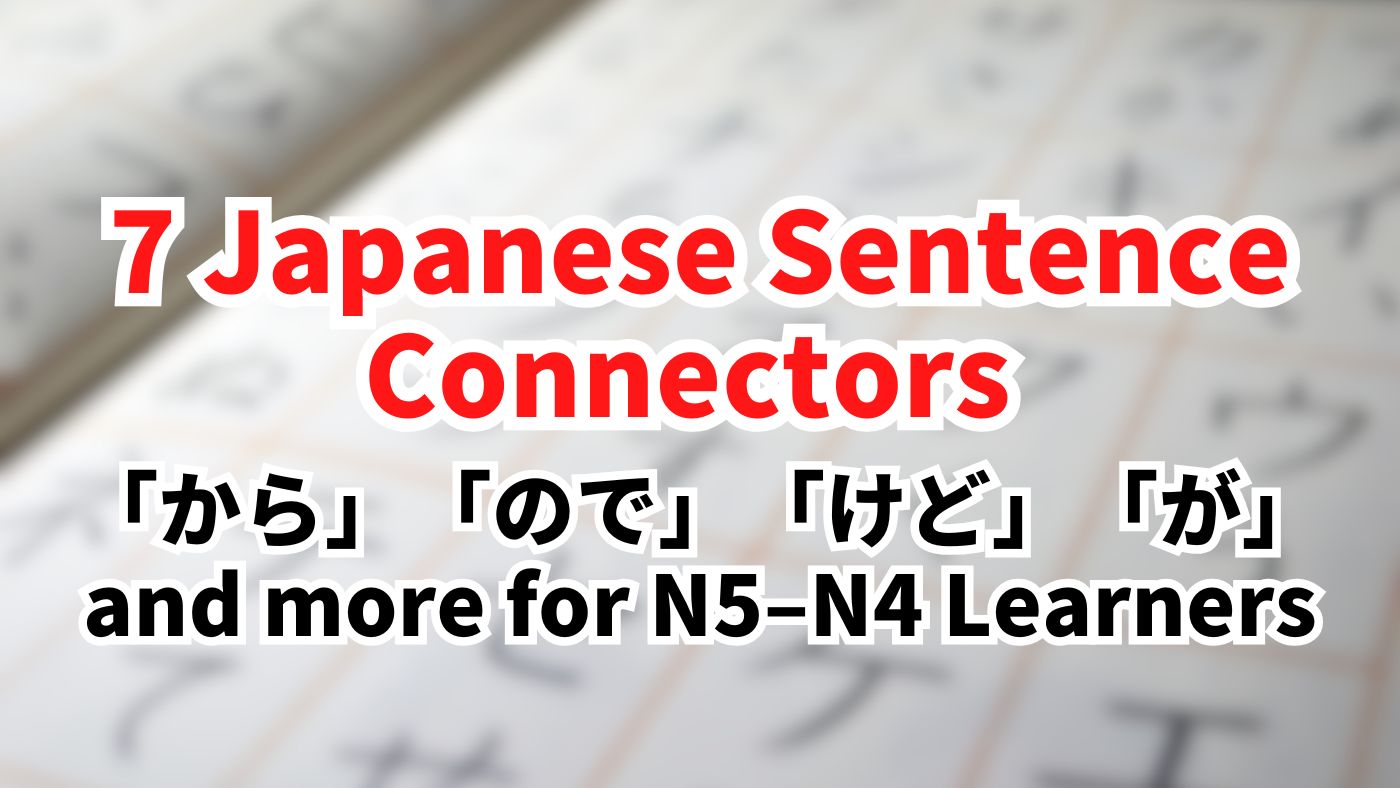
Japanese uses special sentence connectors instead of English words like because or when to connect ideas.These seven sentence connectors are very common and widely used in Japanese.
Key Points to Master Special Sentence Connectors
You may notice labels such as Not recommended or Unnatural in this article. This does not mean that native speakers never use them. In fact, you will hear these expressions quite often in real life.
However, those usages depend heavily on context and can be difficult for learners to control. For this reason, I recommend starting with the safest patterns first. As you become more advanced, you can gradually try more flexible and natural combinations.
There are some exceptions, but in general, it is recommended to connect special sentence connectors to the non-polite (plain) form.
Using polite forms directly with these connectors can easily sound overly polite or unnatural, especially for learners.
✅「雨が止んだから、行けます。」 Use non-polite (plain) form is generally recommended.
△「雨が止みましたから、行けます。」Use polite form is generally tend to unnatural.
Native speakers do sometimes use polite forms with special sentence connectors, but these usages are highly dependent on context. Because of this, they are not recommended for learners to imitate.
Politeness Is Not Just About Polite Forms
If you want to sound polite, it is safer to control politeness in other ways. For example, you can use the polite form in the following clause, or add a polite expression before the sentence.
✅「時間がないから、行けません。」
→ Polite, but it can sound a bit assertive depending on the context.
✅「すいません。時間がないから、行けません。」
→ Adding an apology makes it more polite.
✅「本当にすいません。時間がないから、行けません。」
→ Adding a sincere apology makes it even more polite.
✅「本当にすいません。行きたかったんですが…。時間がないから、行けません。」
→ Adding your feelings makes it very polite and considerate.
7 Basic Japanese Sentence Connectors for Beginners
The connectors are listed in an easy-to-remember order, from the most intuitive to the more complex ones.
| Level | Japanese | Main meaning | Closest English | Example (Non-polite & Polite) |
|---|---|---|---|---|
| N5 | て | sequence / simple reason | and / then | ご飯を食べて、帰る。 ご飯を食べて、帰ります。 |
| N5 | とき | time | when | 日本に行くとき、会う。 日本に行くとき、会いましょう。 |
| N5 | から | reason (direct / speaker-focused) | because | 雨だから、行かない。 雨ですから、行きません。 |
| N4 | ので | reason (softer, considerate) | because / since | 雨なので、行かない。 雨ですので、行きません。 |
| N4 | けど | contrast (spoken) | but | 高いけど、おいしい。 高いですけど、おいしいです。 |
| N4 | が | contrast (neutral / more formal) | but | 高いが、おいしい。 高いですが、おいしいです。 |
| N4 | たら | condition / time | if / when | 時間があったら、行く。 時間がありましたら、行きます。 |
て — sequence / reason
- Part of speech: Conjunctive particle (接続助詞)
- Closest English equivalent: and / then
- Core function: Shows sequence, connection, or a natural flow of actions
- Key role: Links actions smoothly without emphasizing order, contrast, or condition
- Learning importance: Mastering the te-form (テ形) is essential for building natural Japanese sentences
- Usage scope: Many complex sentences in Japanese are built using the te-form
- Tone: Neutral and natural; very common in everyday speech
Form
- Non-polite form + て (most common and natural)
- Polite form + て is grammatically correct but often sounds overly polite or stiff
What comes before て?
Verbs
plain form (〜て) : 家に帰って、ごはんを食べて、寝ます。
polite form (〜まして): 家に帰りまして ❌Grammatically possiblebut sound unnatural
i-adjectives
plain form (〜くて): 安くて、美味しくて、おしゃれ。
polite form (〜です): 安いですて ❌Grammarly incorrect
na-adjectives
plain form (〜で): 元気で、健康で、静かで
polite form (〜です): 元気ですで ❌Grammarly incorrect
nouns
plain form (〜で): 学生で、アメリカ人で、会社員で、母で、
polite form (〜です): 学生ですで ❌Grammarly incorrect
non-polite + て
① Verb(て-form)
ご飯を食べて、寝る。
I eat dinner and then go to sleep.
② i-adjective(て-form)
安くて、美味しい。
Cheap and delicious.
polite + て ⚠️ Sound very unnatural
Polite + て is grammatically correct, but it sounds too polite. Most of the time, it is not used in natural conversation.
Japanese example 3
ご飯を食べまして、寝ます。
I eat dinner and then go to sleep.
Japanese example 4
家に帰りまして、シャワーを浴びます。
I go home and then take a shower.How to use
とき — time / when
- Part of speech: Noun (名詞)
- Closest English equivalent: when / the time when
- Core function: Refers to “the time when something happens”
- Grammatical nature: A noun, not a conjunction or a particle
- Sentence structure: Forms a noun phrase by attaching to a clause before it
- Key rule: The clause before とき must be in plain form (non-polite)
- Reason: とき is a noun and must be modified by a clause, not a sentence-ending form
- Politeness: Politeness is expressed in the main clause, not before とき
- Important restriction: Polite forms (です / ます) cannot appear before とき
Form
- Non-polite form + とき (required)
- Polite form + とき is grammatically incorrect
→ とき is a noun and must be modified by a clause, not a sentence-ending form
What comes before とき?
Verbs
plain form (dictionary or past form) : 家に帰る時 / 家に帰った時
polite form (〜ます / 〜ました): 家に帰ります時 / 家に帰りました時 ❌Grammarly incorrect
i-adjectives
plain form (〜い / 〜かった): 安いとき / 安かったとき
polite form (〜です / 〜かったです): 安いですとき / 安かったですとき ❌Grammarly incorrect
na-adjectives
plain form (〜な / 〜だった): 元気なとき / 元気だったとき
polite form (〜です / 〜でした): 元気ですとき / 元気でしたとき ❌Grammarly incorrect
nouns
plain form (〜の / 〜だった): 学生のとき / 学生だったとき
polite form (〜です / 〜でした): 学生ですとき / 学生でしたとき ❌Grammarly incorrect
non-polite + とき
All of these are non-polite forms because とき is a noun and must be modified by a clause, not a sentence-ending form.
① Verb (dictionary form) + とき
Used for future actions or general situations.
行くとき、教えてください。
Please tell me when you go.
寝るとき、電気を消します。
I turn off the light when I go to sleep.
② Verb (た-form) + とき
Used for completed events or past situations.
日本に行ったとき、彼に会いました。
I met him when I went to Japan.
帰ったとき、部屋は暗かったです。
When I got back, the room was dark.
③ い-adjective + とき
忙しいときは、連絡しません。
I don’t contact people when I’m busy.
④ な-adjective + とき
暇なとき、映画を見ます。
I watch movies when I have free time.
⑤ Noun + の + とき
学生のとき、アルバイトをしていました。
I had a part-time job when I was a student.
polite+ とき (incorrect)⚠️ Grammary incorrect
There is no polite-form + とき combination. The polite forms ます and です are sentence-ending elements and cannot modify the noun とき.
❌ 日本に行きましたとき、会いました。
❌ 忙しいですときは、連絡してください。
→ These sentences are grammatically incorrect and sound very unnatural.
から — reason (casual / direct)
- から can be used after the plain form
- Polite forms (です/ます) can appear before から. But tend to be unnatural.
- A conjunctive particle
- Common in spoken Japanese
- Expresses a subjective / speaker-based reason
- Has a wide range of grammatical flexibility
- Closest English equivalent is “because”
Form
- Non-polite form + から (most common and natural)
- Polite form + から is grammatically possible but often sounds unnatural
→ Politeness is usually expressed in the main clause, not before から
What comes before から?
“Polite forms + から” are grammatically possible, but they tend to sound unnatural.
Verbs
- plain form (dictionary or past form) : 行くから / 行ったから
- polite form (〜ます / 〜ました) : 行きますから / 行きましたから ⚠️ Sounds unnatural
i-adjectives
- plain form (dictionary or past form) : 美味しいから / 美味しかったから
- polite form (〜です / 〜かったです) : 美味しいですから / 美味しかったですから ⚠️ Sounds unnatural
na-adjectives
- plain form (dictionary or past form) : 元気だから / 元気だったから
- polite form (〜です / 〜でした) : 元気ですから / 元気でしたから ⚠️ Sounds unnatural
nouns
- plain form (〜だ / 〜だった) : 学生だから / 学生だったから
- polite form (〜です) : 学生ですから / 学生でしたから ⚠️ Sounds unnatural
non-polite forms + から
① verb (past form) + から
雨が降ったから、行きません。
I won’t go because it’s raining.
② i-adjectve (dictionary form) + から
忙しいから、今日は早く帰ります。
I’m busy, so I’ll go home early today.
③ na-adjectve (dictionary form) + から
私は元気だから、大丈夫です。
I’m fine, so it’s okay.
④ noun + だから
私は学生だから、時間があります。
I’m a student, so I have time.
polite forms + から ⚠️ Tend to be unnatural
“Polite forms + から” are grammatically possible, but they tend to sound unnatural. When using から / ので, keep adjectives in the plain form, and express politeness in the main clause(行きません), not before the connector.
① verb (past masu form) + から
雨が降りましたから、行きません。
I won’t go because it’s raining.
② i-adjectve (dictionary form) + です+ から
忙しいですから、今日は早く帰ります。
I’m busy, so I’ll go home early today.
③ na-adjectve (dictionary form) + です + から
私は元気ですから、大丈夫です。
I’m fine, so it’s okay.
④ noun + です + から
私は学生ですから、時間があります。
I’m a student, so I have time.
How to use
The non-polite form is commonly used in everyday conversation and when speaking with friends or people you are close to.
The polite form is used in formal situations, such as business settings, customer service, or when speaking to superiors.
ので — reason (softer / explanatory)
- ので is normally used after the plain form
- Polite forms (です/ます) can appear before ので. But tend to be unnatural.
- A conjunctive particle
- A clause-linking expression derived from a formal noun
- Expresses an objective / situational reason
- Sounds explanatory, neutral, and polite
- Common in formal explanations and written Japanese
- Politeness is expressed in the main clause (after ので), not before ので
- Has more restricted grammatical use than から
- Closest English equivalents are “since” or “because” (explanatory use)
Form
- Non-polite form + ので (standard and natural)
- Polite form + ので is more acceptable than polite + から, but politeness is still preferably expressed after ので, not before it
What comes before ので?
Verbs
plain form (dictionary or past form) : 行くので / 行ったので
polite form (〜ます / 〜ました): 行きますので / 行きましたので ⚠️ Sounds unnatural
i-adjectives
plain form (dictionary or past form) : 美味しいので / 美味しかったので
polite form (〜です / 〜かったです): 美味しいですので / 美味しかったですので ⚠️ Sounds unnatural
na-adjectives
plain form (〜な / 〜だった): 元気なので / 元気だったので
polite form (〜な / 〜でした): 元気ですなので / 元気でしたので⚠️ Sounds unnatural
nouns
plain form (〜な / 〜だった): 学生なので / 学生だったので
polite form (〜です / 〜でした): 学生ですので / 学生でしたので ⚠️ Sounds unnatural
non-polite + ので
① verb (past form) + ので
雨が降ったので、行きません。
I won’t go because it’s raining.
② i-adjectve (dictionary form) + ので
忙しいので、今日は早く帰ります。
I’m busy, so I’ll go home early today.
③ na-adjective (stem) + なので
私は元気なので、大丈夫です。
I’m fine, so it’s okay.
④ noun + なので
私は学生なので、時間があります。
I’m a student, so I have time.
polite+ ので ⚠️ Tend to be unnatural
「polite forms + ので」 is grammatically possible, but sounds unnatural. When using から / ので, keep adjectives in the plain form, and express politeness in the main clause, not before the connector.
① verb (past form) + ので
雨が降りましたので、行きません。
I won’t go because it’s raining.
② i-adjectve (dictionary form) + です + ので
忙しいですので、今日は早く帰ります。
I’m busy, so I’ll go home early today.
③ na-adjective (stem) + です + ので
私は元気ですので、大丈夫です。
I’m fine, so it’s okay.
④ noun + です + ので
私は学生ですので、時間があります。
I’m a student, so I have time.
How to use
ので is softer and more polite than から.
It sounds less direct and less personal, and is often used to sound considerate.
The non-polite form is still common, but compared with から, ので sounds more formal and gentle.
けど — contrast (casual)
- Part of speech: Conjunctive particle
- Closest English equivalent: but
- Function: Expresses contrast or opposition
- Usage frequency: Very common in spoken Japanese
- Tone: Casual, soft, and conversational
- Pragmatic nuance: Often used to gently add information or soften a statement
Form
- Non-polite form + けど (very common in spoken Japanese)
- Polite form + けど is also natural and widely used
→ Style mixing is generally tolerated with けど
What comes before けど?
Verbs
plain form (dictionary or past form) : 言うけど / 言ったけど
polite form (〜ます / 〜ました): 食べますけど / 食べましたけど
i-adjectives
plain form (〜い / 〜かった): 美味しいけど / 美味しかったけど
polite form (〜です / 〜かったです): 美味しいですけど / 美味しかったですけど
na-adjectives
plain form (〜だ / 〜だった): 元気だけど / 元気だったけど
polite form (〜です / 〜でした): 元気ですけど / 元気でしたけど
nouns
plain form (〜だ / 〜だった): 学生だけど /学生だったけど
polite form (〜です / 〜でした): 学生ですけど / 学生でしたけど
non-polite + けど
① verb (plain form) + けど
高いけど、おいしいです。
It’s expensive, but it’s delicious.
② verb (たい-form) + けど
行きたいけど、時間がありません。
I want to go, but I don’t have time.
polite + けど
③ i-adjective+けど
高いですけど、おいしいです。
It’s expensive, but it’s delicious.
② verb (たい-form) + けど
行きたいですけど、時間がありません。
I want to go, but I don’t have time.
How to use
けど and が both express contrast, similar to “but” in English.
Both can be used with non-polite or polite sentence forms.
- が
- sounds slightly more formal
- often used in polite speech or writing
- けど
- more common in spoken Japanese
- sounds casual and conversational
In everyday conversation, けど is more frequent.
In polite explanations or written Japanese, が is often preferred.
が — contrast (formal)
- Part of speech: Conjunctive particle (接続助詞)
- Closest English equivalent: but
- Function: Expresses contrast, opposition, or reservation
- Tone: More formal and firm than けど
- Usage context: Common in polite explanations, written Japanese, and careful speech
- Stylistic rule: Requires consistent speech style within the sentence (polite + polite / non-polite + non-polite)
Form
- Polite form + が (standard and natural)
- Non-polite form + が is grammatically correct but sounds formal, firm, or literary
→ Consistent speech style within the sentence is important
What comes before が?
Verbs
plain form (dictionary or past form) : 何度も言うが / 何度も言ったが
polite form (〜ます / 〜ました): 何度も言いますが / 何度も言いましたが
i-adjectives
plain form (〜い / 〜かった): 安いが / 安かったが
polite form (〜です / 〜かったです): 安いですが / 安かったですが
na-adjectives
plain form (〜だ / 〜だった): 元気だが / 元気だったが
polite form (〜です / 〜でした): 元気ですが / 元気でしたが
nouns
plain form (〜だ / 〜だった): 学生だが / 学生だったが
polite form (〜です / 〜でした): 学生ですが / 学生でしたが
non-polite+ が ⚠️ Not recommended
Using 「non-polite forms with が」 can sound strong and somewhat assertive, so it is generally not recommended.
① verb (plain form) + が
高いが、おいしい。
It’s expensive, but it’s delicious.
② verb (たい-form) + が
行きたいが、時間がない。
I want to go, but I don’t have time.
polite + が
③ i-adjective+が
高いですが、おいしいです。
It’s expensive, but it’s delicious.
② verb (たい-form) + が
行きたいですが、時間がありません。
I want to go, but I don’t have time.
Match your speech style
With が, consistency in speech style is important. When the first clause is in the non-polite form, the clause that follows is normally non-polite as well. Mixing non-polite and polite styles within the same sentence often sounds unnatural.
✅ 行きたいが、時間がない。
✅ 行きたいですが、時間がありません。
→ sounds natural because both clauses use the polite style.
❌ 行きたいが、時間がないです。
→ sounds awkward because the first clause is non-polite while the following clause switches to the polite style.
❌ 行きたいですが、時間がない。
→ sounds awkward because the first clause is polite while the following clause switches to the non-polite style.
How to use
が also means “but”, but it sounds more formal and firm.
- less common in casual conversation
- sounds more like written Japanese
- gives a stronger, more assertive tone
When to use
- polite explanations
- formal or semi-formal situations
- writing or careful speech
Important usage rule
- Non-polite form + が is rare in conversation
- In daily speech, if you use が, use polite form + が
- When speaking to superiors or in formal situations,
always use polite form + が
Simple guideline
- friends → けど
- polite / formal → polite form + が
たら — condition (if / when)
- Part of speech: Conjunctive particle (接続助詞)
- Closest English equivalent: if / when
- Core function: Expresses a condition that leads to a result
- Key characteristic: Always uses the past form (た-form) , even for future situations
- Learning note: This is different from English and can feel confusing at first
- Form explanation: Grammatically, ら attaches to the past form, but for learning purposes it is taught as たら
- Prerequisite: Learning the た-form is necessary to use たら
Form
- Past form (た-form) + ら (always required)
- Polite form (ました+ら) is grammatically possible but sounds overly polite.
- Polite form (でした+ら) is grammatically possible but sounds overly polite.
→ Learning the た-form(past-form) is essential to use たら
What comes before たら?
Verbs
plain form (〜た) : 家に帰ったら
polite form (〜ました): 家に帰りましたら ❌Sound overly polite
i-adjectives
plain form (〜かった): 安かったら
polite form (〜かったです): 安かったですたら ❌Grammarly incorrect
na-adjectives
plain form (〜だった): 元気だったら
polite form (〜でした): 元気でしたら ❌Grammarly acceptable, but sound unnatural
nouns
plain form (〜だった): 学生だったら
polite form ( 〜でした): 学生でしたら ❌Grammarly acceptable, but sound unnatural
non-polite Verb(た-form) + たら
① Verb(た-form)+たら
忙しかったら、行きません。
If I busy, I won’t go.
② Verb(た-form)+たら
時間があったら、映画を見たいです。
If I have time, I’d like to watch a movie.
polite + たら ⚠️ Not recommended
The ます-form itself cannot be directly followed by たら. What is actually used is the past polite form, ました+ら.
Japanese example 3 – Grammatically possible but overly polite
△ 時間がありましたら、手伝ってください。
If you have time, please help.
The です-form itself cannot be directly followed by たら. What is actually used is the past polite form, でした+ら.
Japanese example 4-1 – Grammatically incorrect
❌ 忙しいですたら、行きません。
If I busy, I won’t go.How to use
Japanese example 4-2 – Grammatically possible but sound unnatural
△ 東京に行くのでしたら、教えてください。
If you’re going to Tokyo, please let me know.
Conclusion
In this article, you learned how to use seven essential beginner-level sentence connectors:
- て — to link actions in sequence
- とき — to describe time
- から / ので — to give reasons
- けど / が — to show simple contrast or background
- たら — to express basic conditions
These connectors allow you to describe what happens, when it happens, and why it happens in everyday Japanese.
At this stage, your focus is mainly on connecting events and situations clearly.
What you’ll study next
You’ll learn connectors such as:
- と — automatic result
- ば — logical judgment
- なら — reaction to known information
- のに — broken expectation
- ため(に) — objective cause
👉 Read the intermediate guide here:
5 Japanese Sentence Connectors You Learn at Intermediate (N3–N2)