
“このバッグ、軽いし、可愛いし、雨にも強いし、とても気に入ってます!”
(Kono baggu, karui shi, kawaii shi, ame ni mo tsuyoi shi, totemo ki ni itte masu!)
“This bag is light, cute, and even water-resistant—I really like it!”
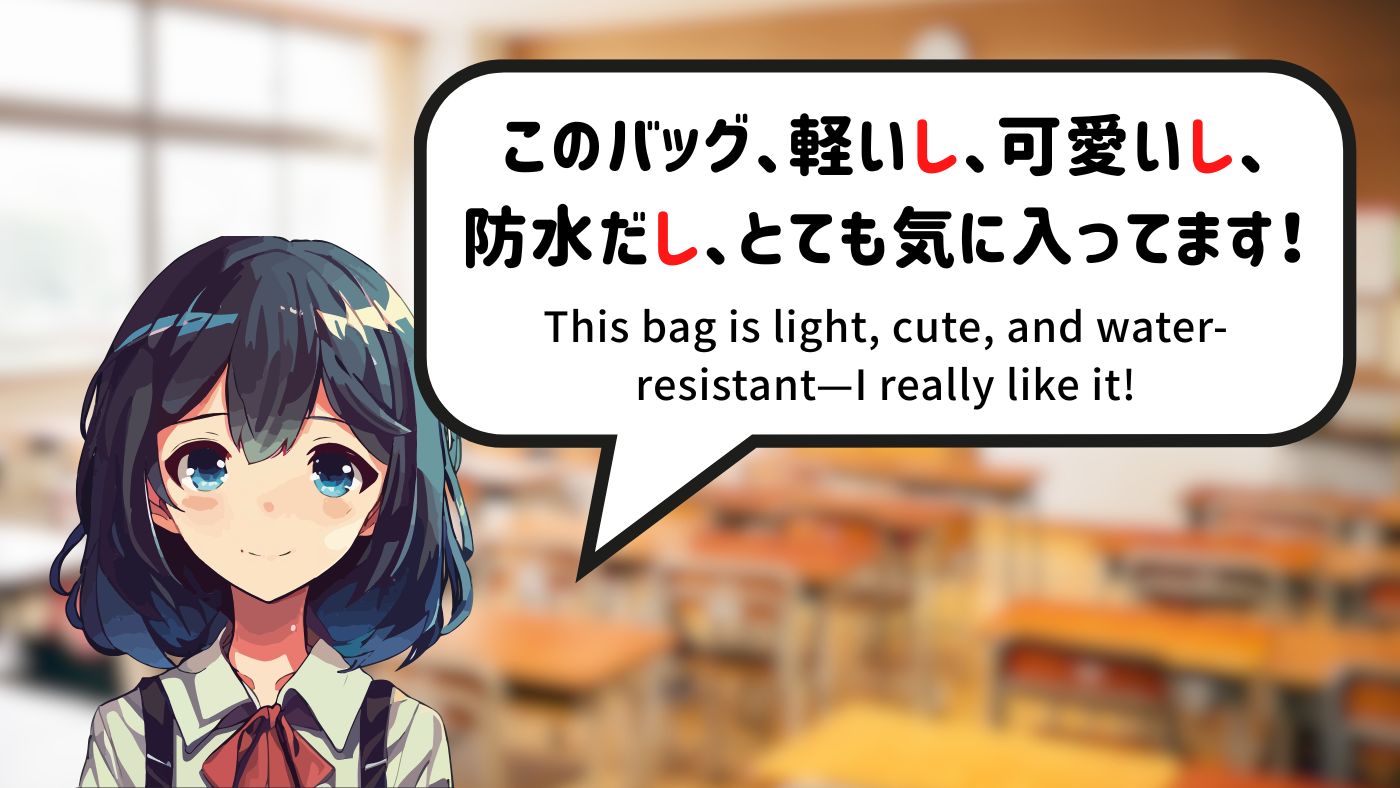
In this example, the particle 〜し is used to list multiple reasons or characteristics in a soft, natural way.
Although it’s introduced early in Japanese learning (usually in the lower beginner level), 〜し has more depth than it seems. In this guide, I’ll explore its grammatical functions, what kinds of words can be connected using it, and how it compares to similar expressions like 〜て, 〜から, and 〜ので.

✅ What is “〜し” and how does it work?
〜し is a conjunctive particle (接続助詞) that connects clauses or reasons. It is often used to softly list multiple facts, reasons, or feelings without stating a strong conclusion like “because” does.
It’s most commonly used in conversation to add nuance and layering to your thoughts.
✅ The 3 Main Uses of “〜し” + 1 Special Case
① Listing Reasons (Causal Parallel)
Used to give multiple reasons for an action or decision.
📘 Example:
- このアパートは駅から近いし、家賃も安いし、すぐ決めました。
- (Kono apaato wa eki kara chikai shi, yachin mo yasui shi, sugu kimemashita.)
- “This apartment is close to the station and cheap, so I decided on it right away.”
📘 Example:
- 風邪っぽいし、頭も痛いし、今日は休もうと思います。
- (Kazeppoi shi, atama mo itai shi, kyou wa yasumou to omoimasu.)
- “I feel like I have a cold and my head hurts, so I think I’ll take a day off today.”
② Listing Characteristics (Descriptive Parallel)
Used to describe features or traits in a layered and subjective way.
📘 Example:
- このバッグ、軽いし、水に強いし、デザインもいい!
- (Kono baggu, karui shi, mizu ni tsuyoi shi, dezain mo ii!)
- “This bag is light, water-resistant, and has a great design!”
📘 Example:
- 彼女は優しいし、仕事もできるし、気が利くよね。
- (Kanojo wa yasashii shi, shigoto mo dekiru shi, ki ga kiku yo ne.)
- “She’s kind, competent at work, and really considerate.”
③ Emphasizing Emotion or Subjectivity
Used to express rising emotion, especially in casual or personal speech.
📘 Example:
- あのカフェ、落ち着いてるし、おしゃれだし、最高!
- (Ano kafe, ochitsuite ru shi, oshare da shi, saikou!)
- “That café is relaxing, stylish… it’s the best!”
📘 Example:
- この映画、感動するし、映像もきれいだし、本当に観てよかった!
- (Kono eiga, kandou suru shi, eizou mo kirei da shi, hontou ni mite yokatta!)
- “This movie was touching, visually beautiful—I’m so glad I watched it!”
Special: Ellipsis or Suggestion (Trailing “〜し”)
Leaves the sentence unfinished to imply there are more (sometimes negative) reasons.
📘 Example:
- あの人、ちょっとね…話長いし…。
- (Ano hito, chotto ne… hanashi nagai shi…)
- “That person… talks a lot and… you know…”
📘 Example:
- 別に嫌いじゃないけど…あんまり関わりたくないし…。
- (Betsu ni kirai ja nai kedo… anmari kakawaritakunai shi…)
- “I don’t hate them or anything, but… I’d rather not get involved.”
✅ What Parts of Speech Connect to “〜し”?
You can attach “〜し” to four major parts of speech:
| Part of Speech | Connection Form | Example (Japanese) | English Translation |
|---|---|---|---|
| i-adjective | Dictionary form + し | 安いし、軽いし | Yasui shi, karui shi – Cheap and light |
| na-adjective | Dictionary form(〜だ)+ し | 静かだし、便利だし | Shizuka da shi, benri da shi – Quiet and convenient |
| verb | Plain form + し | 働くし、食べたし | Hataraku shi, tabeta shi – (I) work and (I) ate |
| noun | Dictionary form(〜だ)+ し | 医者だし、学生だし | Isha da shi, gakusei da shi – (He) is a doctor and a student |
✅ Comparison with Similar Expressions
There are a few expressions in Japanese that may seem similar to “〜し” but are used in slightly different ways depending on nuance and context. Here’s how they differ:
● 〜し
Used for subjective listing of reasons, traits, or feelings. Often appears in casual or personal speech.
- このバッグ、軽いし、可愛いし、雨にも強いし、気に入ってます。 (Kono baggu, karui shi, kawaii shi, ame ni mo tsuyoi shi, ki ni itte masu.) → “It’s light, cute, water-resistant—I love it!”
- Nuance: soft, emotional, layered.
● 〜て
Used to factually list states or characteristics.
- このバッグは軽くて、可愛くて、雨にも強いです。 (Kono baggu wa karukute, kawaikute, ame ni mo tsuyoi desu.) → “This bag is light, cute, and water-resistant.”
- Nuance: neutral, descriptive, objective.
● 〜から
Used to show a clear reason and result.
- 軽いから、このバッグを選びました。 (Karui kara, kono baggu o erabimashita.) → “I chose this bag because it’s light.”
- Nuance: logical, direct, often used for giving explanations.
● 〜ので
Used for polite and explanatory reasons.
- 軽いので、このバッグを選びました。 (Karui no de, kono baggu o erabimashita.) → “Since it’s light, I chose this bag.”
- Nuance: polite, formal, often used in writing or public speech.
✅ Nuance Comparison
| Expression | Function / Use Case | Nuance (Tone / Context) |
|---|---|---|
| 〜し | Subjective listing (reasons, traits, feelings) | Soft, emotional, personal. Adds emphasis or emotion to evaluation. Often used in spoken language. |
| 〜て | Objective listing of features or states | Neutral, factual, and descriptive. Often appears in explanations or written texts. |
| 〜から | Clear reason → result | Logical and explanatory. Often used when giving personal reasons or justifications. |
| 〜ので | Polite, formal reason → result | Formal and polite. Softer than “〜から”; often used in formal speech or writing. |
✅ When and How to Learn “〜し” in Japanese
Level, tips, and practice ideas for learning the connector “〜し”
🌱 Recommended Level
“〜し” is best learned at the late beginner to early intermediate level (JLPT N5–N4).
You’ll find it in popular Japanese textbooks:
- Genki II – Lesson 17
- Minna no Nihongo II – Lesson 28
🎯 Key Points for Learning “〜し”
- Start with adjectives like “yasui” (cheap) or “kawaii” (cute).
These are easy to connect with your feelings and opinions. - “〜し” is commonly used in real-life, casual speech, especially to show emotions or personal reasons.
- Compare it with other connectors like “〜て” and “〜から” to understand the different nuances.
🛠 Practice Ideas for Students
“My Favorite Thing” Activity
Talk about something you love using “〜し” to give reasons. このアニメ、ストーリーが面白いし、キャラもかわいいし、大好き!
(Kono anime, sutoorii ga omoshiroi shi, kyara mo kawaii shi, daisuki!)
→ “This anime has a fun story, the characters are cute—I love it!”
“What I Don’t Like” Practice
Practice negative opinions with “〜し”. 高いし、重いし、デザインも好きじゃないし…
(Takai shi, omoi shi, dezain mo suki janai shi…)
→ “It’s expensive, heavy, and I don’t even like the design…”
“Unfinished Sentences” Game
Hear a trailing “〜し…” and guess what it means. 今日ちょっと…疲れてるし…
(Kyou chotto… tsukareteru shi…)
→ “Today I’m kind of… tired, and…” → Implied: “So I don’t want to go out.”
✍️ Summary
Learning “〜し” helps you express your thoughts and feelings in a natural, friendly way.
It’s a great tool for sounding more fluent and emotional in Japanese!
- When you want to list several things
- When you want to express your emotions
- When you don’t want to state a reason too directly
In these situations, “〜し” is very helpful.
✨ Want to master “〜し” and sound more natural in Japanese?
Join my lesson and start using it like a native!